Metaveillance Vehicle for Sensing Ultrasonic Sensors: A Proof-of-Concept for Secure Medical Deployment in Conflict Zones
IEEE International Conference on Mechatronics and Automation (ICMA) 2026
Changchun, China, August 2026 · Published; full paper on IEEE Xplore
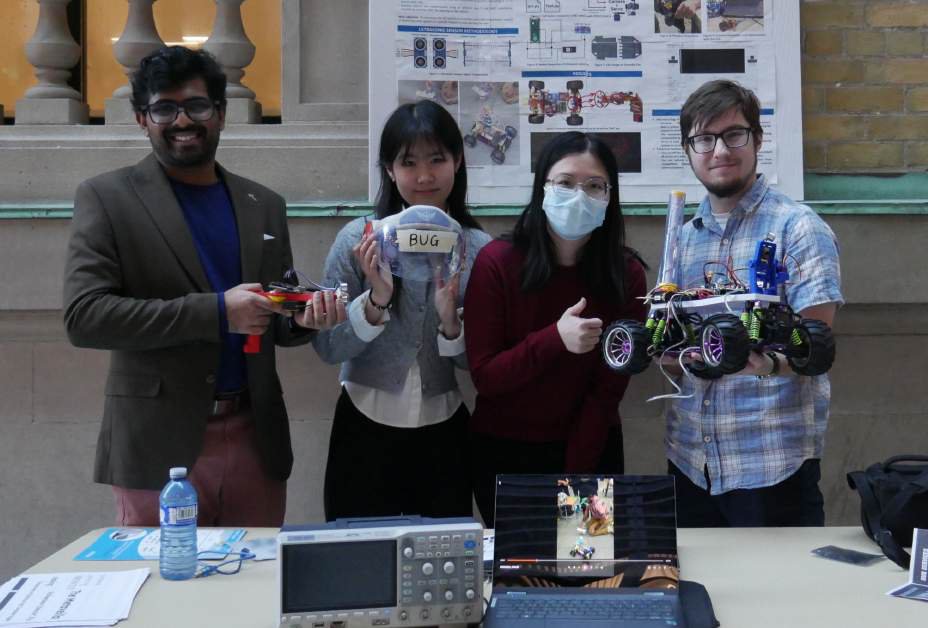
The metaveillance vehicle at the ECE516 symposium.
Metaveillance, Mann’s term for the sensing of sensors, goes mobile. A remote-controlled ground vehicle carries an ultrasonic meta-sensing front end that taps the analog behaviour of a modified HC-SR04 module rather than its trigger/echo abstraction, so it can hear other devices’ 40 kHz chirps.
An RP2040 samples and verifies the chirps by zero-crossing frequency checks, an ESP32-CAM on a 3-D-printed two-axis mount gives a live view, and a Python GUI handles teleoperation. The result is a proof of concept for remote bug sweeping and operator-protective inspection where hidden sensing infrastructure is a privacy or safety concern, such as medical deployments in conflict zones.
Abstract
This paper presents the design and implementation of a mobile metasurveillance (more generally, metaveillance) vehicle for the sensing of sensors, and in particular, sensing ultrasonic sensors. The system combines a remote-controlled ground vehicle, an ultrasonic meta-sensing front-end, embedded signal processing, a live camera feed, and a desktop control interface. Rather than relying only on the default trigger/echo abstraction of a low-cost ultrasonic module, the platform accesses the analog behavior of the sensing circuitry directly to monitor external ultrasonic chirps. The prototype uses an RP2040-based acquisition pipeline to sample the analog output of a modified HC-SR04 front-end, applies zero-crossing based frequency verification around 40 kHz, and communicates verified events to a visual feedback subsystem. An ESP32-CAM mounted on a two-degree-of-freedom 3D-printed support platform provides live remote viewing, while a Python graphical user interface supports teleoperation and system monitoring. Together, these components form a proof-of-concept platform for remote bug sweeping and operator-protective inspection in settings where hidden sensing infrastructure may be a privacy or safety concern.
Authors
Vishweswar Eswaran, Piotr Miroslaw Nowak, Lily Kim, Ciel Li, Alexander Vicol, Steve Mann
Links
- Paper on IEEE Xplore (DOI 10.1109/ICMA69663.2026.11647613)
- Also in the Mersivity / WaterHCI 2026 Symposium Proceedings (Zenodo)
- Related project: Submersivity