State-of-Float: From Balling to Future Space Travel
IEEE International Conference on Consumer Electronics (ICCE) 2026
Dubai, United Arab Emirates, February 2026 · Published; full paper on IEEE Xplore
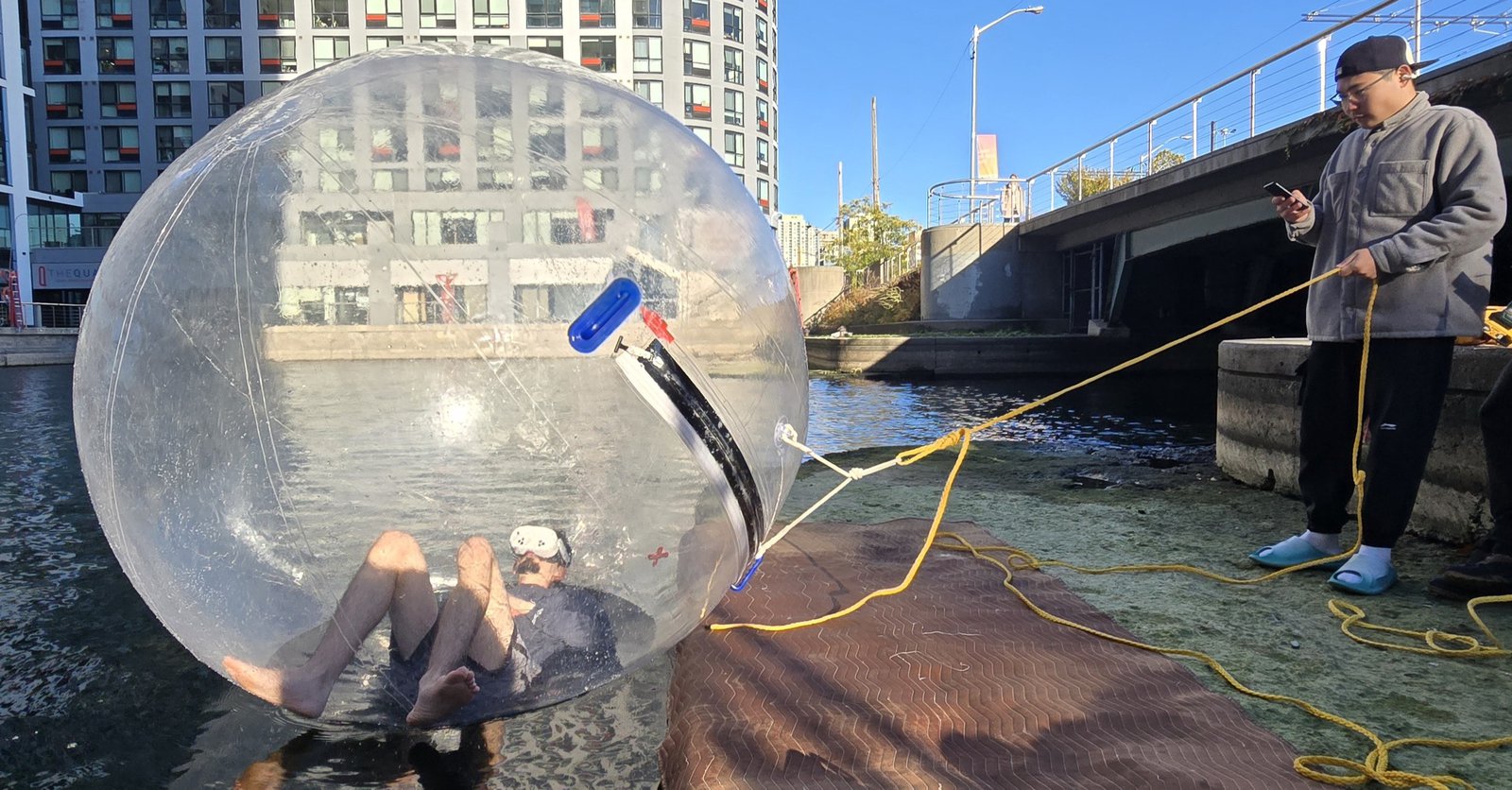
Lying supine inside the water-walking ball on Peter Street Basin, Toronto, wearing a Muse S Athena EEG headband under a Meta Quest headset. A tether runs to an attendant on the dock.
What does the brain do when the body floats? Participants lay supine inside a transparent, 1 m-radius water-walking ball, first on land and then floating on the water, wearing a Muse S Athena EEG headband and a Meta Quest headset that showed only a fixation point, in eyes-open and eyes-closed blocks.
In this pilot, floating was associated with higher theta-to-beta ratios, an index of attentional control and arousal, and participants reported feeling calmer. CO2 inside the sealed ball was monitored throughout to keep sessions within accepted limits. The arc continues with State-of-Flight (wearable EEG while flying or floating) and, one day, the neuroscience of space travel.
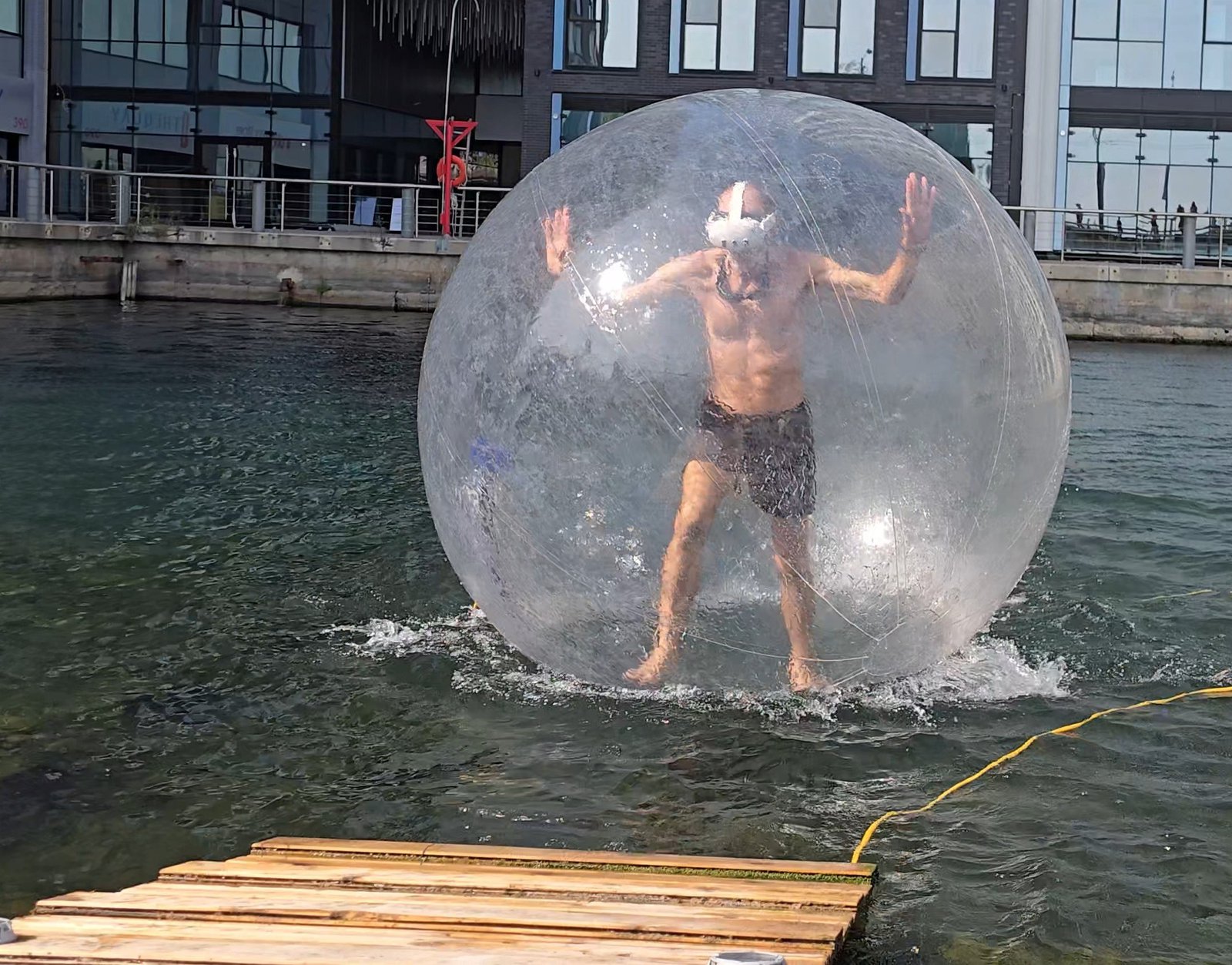
Balling on Peter Street Basin: the water-walking ball is our floating laboratory.
Abstract
We explore what we call the “State-of-Float,” or “Float-State,” inspired by the well-known concept of the “Flow State” or “State of Flow”. We use this idea to discuss and measure the experiences of individuals who are floating. To study the floating experience, we used the Muse S Athena brain-sensing headband to collect raw electroencephalography (EEG) data from participants as they floated inside a water-walking ball. The Muse is a widely used consumer electronics device. Data from the Muse was processed and compared to EEG recordings taken while participants were, one at a time, in the ball on land and on water. The on-land recordings in the ball served as the control condition. During the experiment, participants wore a Meta Quest 3 VR headset displaying a simple black background with a fixed point. Participants received auditory cues guiding them on when to focus on the point and when to close their eyes. Participants reported feeling calmer and showed a higher theta/beta ratio (TBR) when lying supine on water than on land, with this effect present for both eyes open and eyes-closed conditions. Together, the data indicate a consistent pattern that may reflect a distinct State-of-Float. We also present findings in support of “Balling” safety in regards to carbon-dioxide buildup in a ball.
Authors
Steve Mann, Alexander Vicol, Nagham Sabbour, Gesi Wodu, Kinkini Monaragala, Xiaoming Chen, Patryk Aniolowski
Links
- Paper on IEEE Xplore (DOI 10.1109/ICCE67443.2026.11449719)
- Also in the Mersivity / WaterHCI December-2025 Symposium Proceedings (Zenodo)
- Related project: State-of-Flight
- Related project: Chirplets in the Snow