Asymmetric-Gaussian Chirplet Transform for EEG, by LLM-Guided Search for Chirplets
28th Annual Mersivity / WaterHCI Symposium 2026
Toronto and online, March 30 to May 10, 2026 · Published in the symposium proceedings (open access on Zenodo)
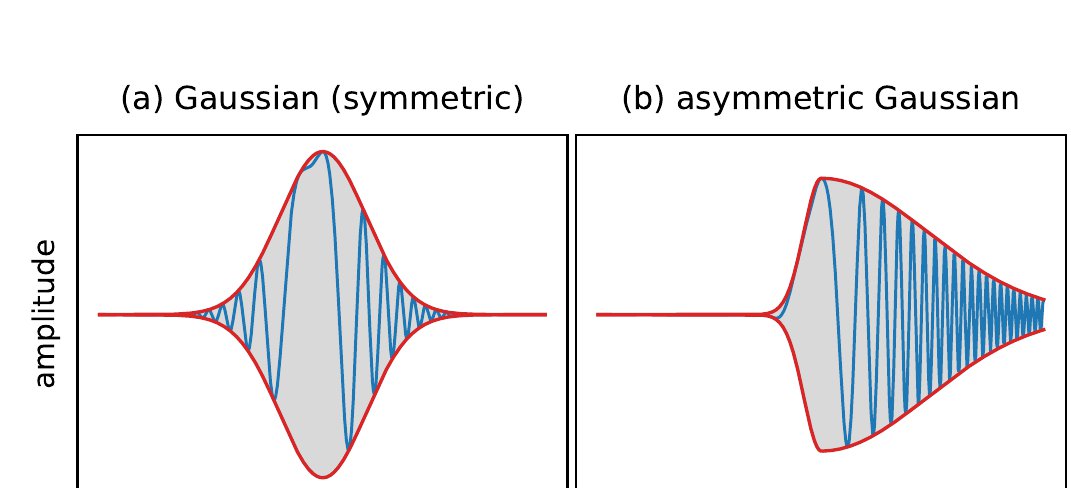
Figure 1 of the paper: the classical symmetric Gaussian atom (left) and the discovered asymmetric one (right), a sharp onset and a slow decay, which is what real neural bursts look like.
The Adaptive Chirplet Transform breaks a signal into Gaussian-windowed chirps. Every version since 1995 has kept Mann and Haykin's symmetric Gaussian envelope. We asked an evolutionary search, guided by language models in the spirit of FunSearch, to propose other atoms, and the winner was a Gaussian with different left and right widths, a sharp onset and a slow decay, which is what real neural bursts look like. With an analytic gradient it reconstructs held-out EEG better at no extra cost, and the ladder of richer atoms keeps climbing to seven parameters. We also report, straight, where the gain does not transfer.
Abstract
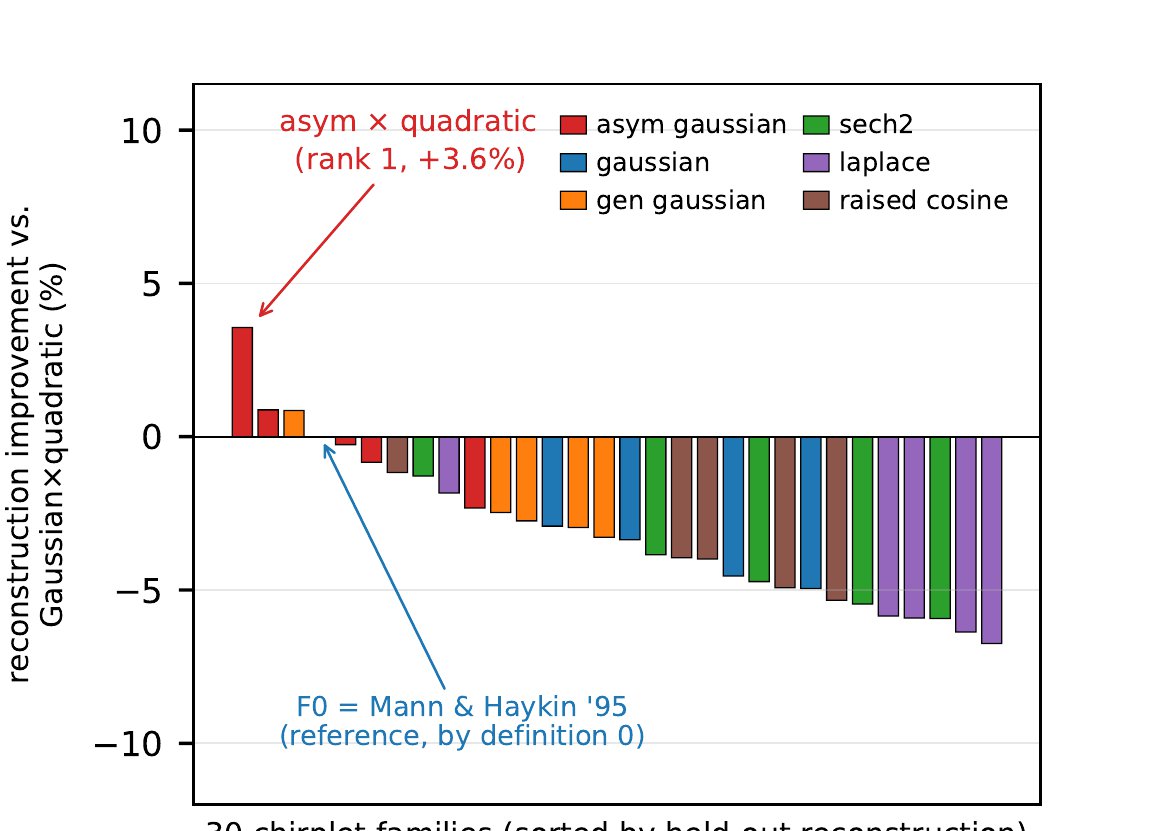
The Adaptive Chirplet Transform (ACT) decomposes non-stationary signals into Gaussian-windowed chirps. Three decades of refinement have improved the optimiser but never questioned the atom: every version keeps Mann and Haykin's 1995 symmetric-Gaussian envelope and quadratic phase. We apply an LLM-guided evolutionary search, in the spirit of FunSearch, over a grammar of 30 envelope/phase atom families, and ask whether that atom is optimal for scalp EEG. An asymmetric-Gaussian envelope — a Gaussian with independent left and right widths — is the standout. Engineered to flagship grade with a closed-form analytic gradient and a diagonal-seeding trick that keeps the dictionary cost at baseline, the resulting transform (ACTv9Asym, 5 parameters) reduces held-out EEG reconstruction error by 4.6% (Wilcoxon p < 10⁻¹³, better on 88% of epochs). The same pattern climbs: ACTv10 (6 params, +log phase) +6.3%, ACTv11 (7 params, also asymmetric chirp) +10.4% (p < 10⁻¹⁵, 96% of epochs better), ACTv12 (8 params, also asymmetric log) only +10.7% — the ladder saturates at 7 parameters. The analytic gradient is what makes the ladder pay: without it, all higher-parameter variants reconstruct held-out EEG worse than the baseline by ≈20%. Two real downstream artifact tasks (jaw-vs-motion, rowing-vs-rest) are null — both are decided by coarse spectral structure that the baseline already captures — but a controlled synthetic shape-classification task picks up the reconstruction gain at every rung above v8 (+5.8 pts for v10, p = 0.003 on gradient boosting). The null is task-dependent, not transform-dependent.
Authors
Alexander Vicol, Steve Mann
Links
- Paper in the Mersivity / WaterHCI 2026 Symposium Proceedings (Zenodo, open access)
- Related project: Chirplets in the Snow
- Related project: Chirplets for Gravitational Waves
- Related project: Chirplets for Sleep Staging