Chirplet-Based Analysis of Gravitational-Waves: From Classical Chirplets to Best Chirplet Chains
27th Annual Mersivity / WaterHCI Symposium, December 2025
Toronto and online, December 4 to 21, 2025 · Published in the symposium proceedings (open access on Zenodo)
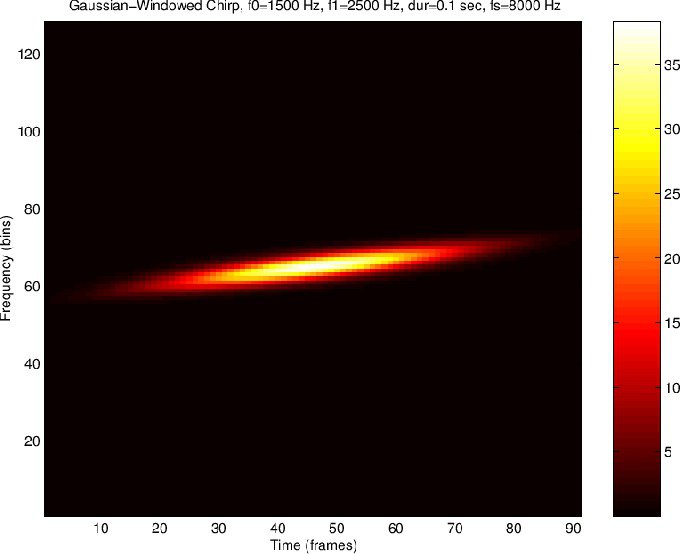
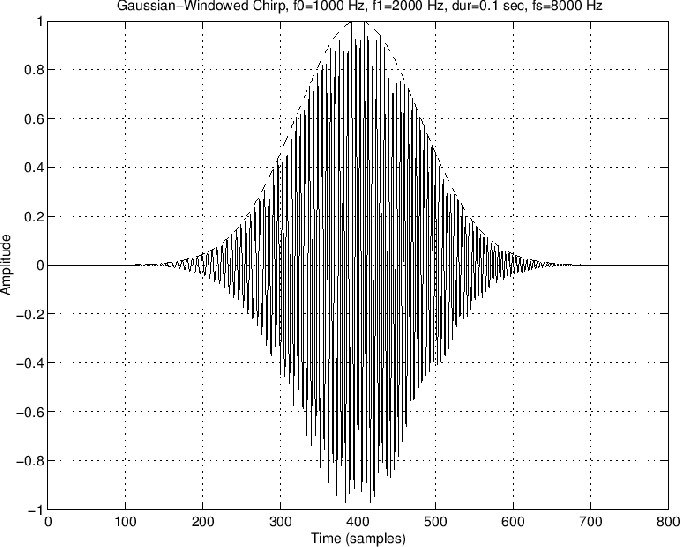
A chirplet in time and frequency, from the paper: a Gaussian-windowed chirp sweeping upward in frequency, the atom the whole analysis is built from.
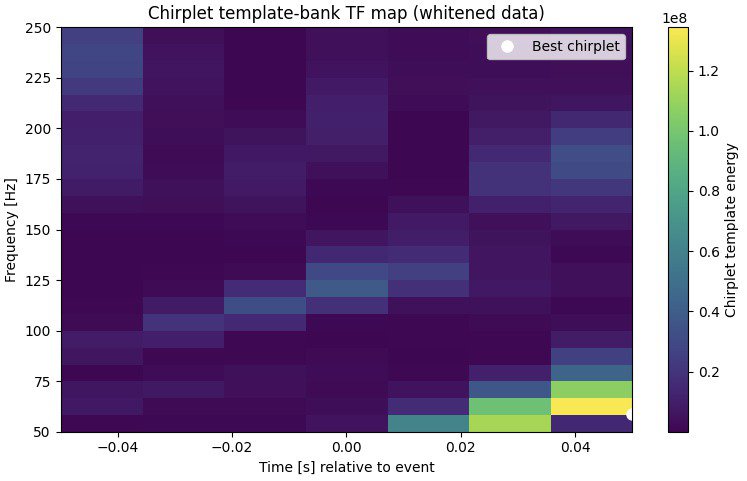
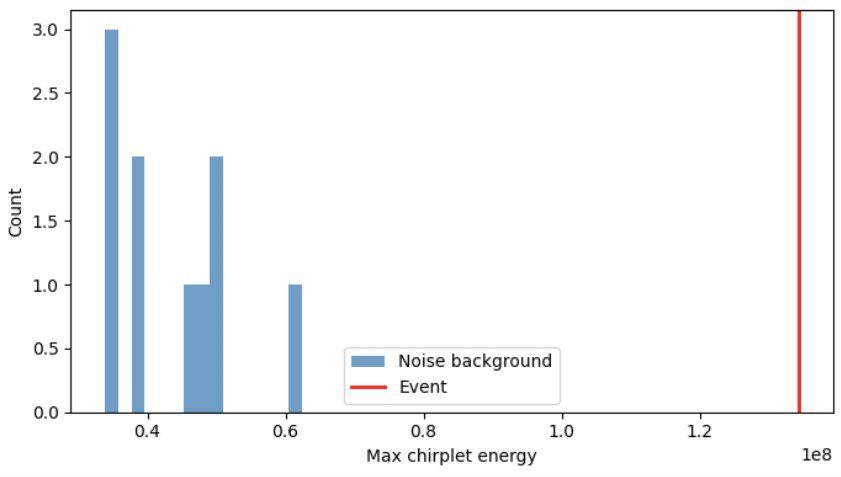
A gravitational wave from two merging black holes is a chirp: a tone that rises in frequency and amplitude in a fraction of a second. Mann and Haykin's chirplet transform was built for exactly that shape of signal, in 1991, for sonar. This paper takes it to LIGO-style data, from single chirplets to chains of them that follow the whole inspiral, and compares the detection statistics against a noise background.
Abstract
Gravitational-wave (GW) signals from compact binary coalescences are highly non-stationary and chirp-like, with time-varying instantaneous frequency and amplitude. Standard time–frequency approaches such as the short-time Fourier transform, wavelet transform, and the Q-transform provide important tools for burst search pipelines, but their fixed time–frequency tilings can be suboptimal for rapidly evolving chirps. Chirplet transforms generalize Gabor and wavelet atoms by introducing a chirp-rate parameter and, more broadly, families of time-varying modulations. In this paper we review classical chirplet theory, connect it to the physics of GW polarizations, and illustrate how the Best Chirplet Chain (BCC) framework can be used to detect and reconstruct the GW150914 binary black hole merger in open LIGO data. We show a simple Python implementation that downloads and whitens public strain data, computes a Gaussian-chirplet transform, and builds a BCC-style chirplet chain that tracks the inspiral chirp in the time–frequency plane, and briefly outline a similar workflow for GW190521.
Authors
Alexander Vicol, Syed Ali Sher, Xiaoming Chen, Steve Mann
Links
- Paper in the Mersivity / WaterHCI December-2025 Symposium Proceedings (Zenodo, open access)
- Related project: Asymmetric Chirplets
- Related project: Chirplets in the Snow
- Related project: Chirplets for Sleep Staging