Boardmusic: Attention, Assemblage, and Improvisation on Water
IEEE Gaming, Entertainment, and Media Conference (GEM) 2026
Berlin, Germany, September 2026 · Published; full paper on IEEE Xplore
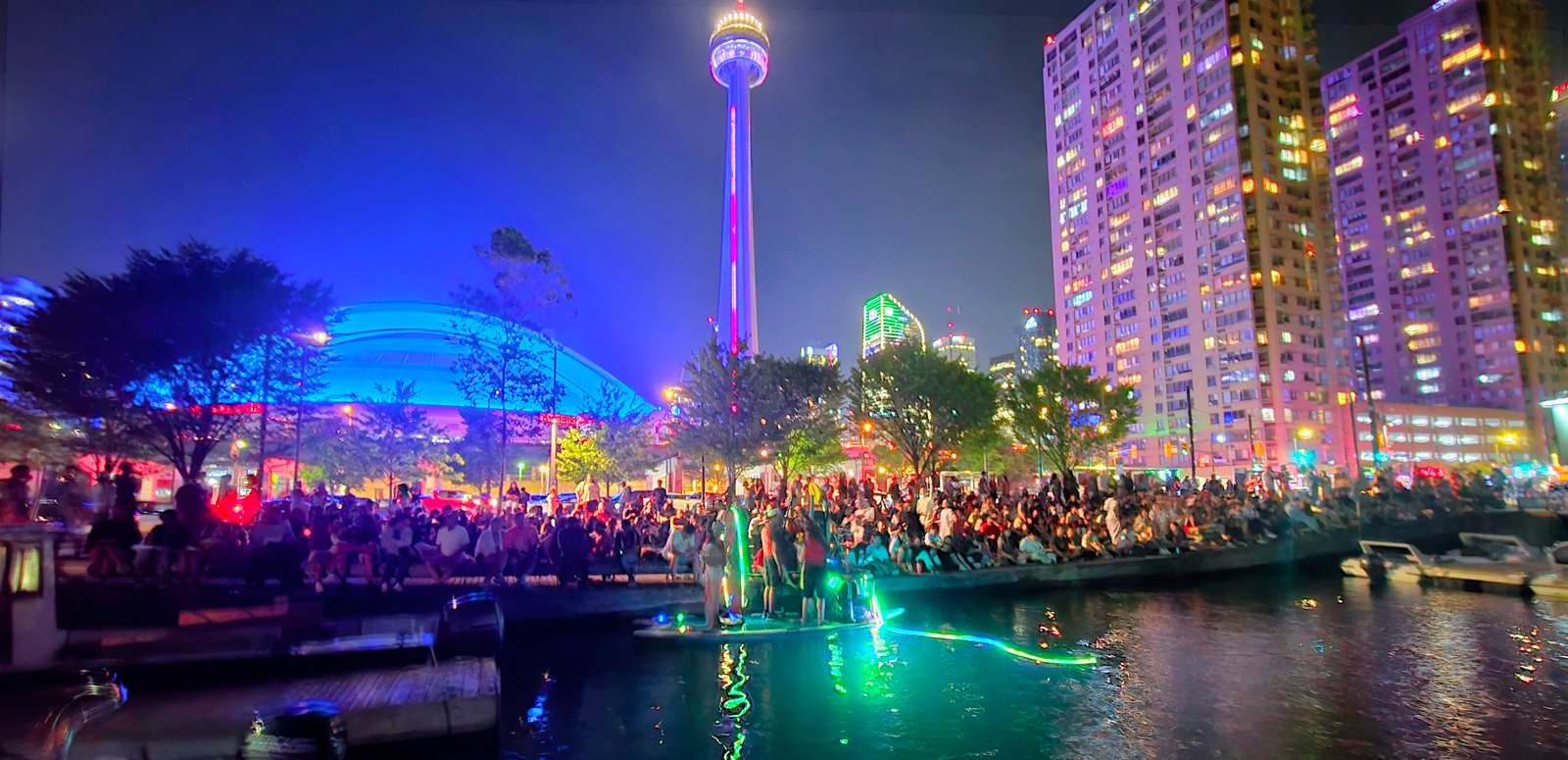
Boardmusic at HTO Beach: the performer plays the twelve-jet hydraulophone from a crew-carried paddleboard while hundreds watch from the shore.
The hydraulophone is played by pressing fingers into jets of water, so it responds to absement, the time-integral of displacement, rather than to velocity like a piano. Boardmusic is an improvised electroacoustic performance on that instrument from a paddleboard carried across the lake, with a lavalier clipped to the performer’s nose ring, hydrophone pickups, an iOS mixer, chord grid, drum machine and a portable PA all riding on the board.
The paper uses the performance to test whether embodied connection to the environment survives a competing control surface, and names the result attentional tax: the touchscreen took very little time but cost the most attention, breaking the continuous-pressure flow the music demanded. It also proposes the “three roles of water” as a framing for WaterHCI performance design.
Abstract
The hydraulophone responds to the continuous pressure of fingers against water jets: not velocity, as in a piano; not displacement, as in an organ; but absement, the time-integral of displacement. This paper presents Boardmusic, an improvised electroacoustic performance on a paddleboard carried across a lake. Water is both stage and medium: raw, unfiltered, producing sound through twelve jets, destabilizing the performer, and surrounding the instrument. A lavalier clipped to a nose-ring piercing couples the performer’s voice to the signal chain. The piercing functions as an interface point: body to wire to mix. Hydrophone pickups, an iOS mixer, chord grid, drum machine, and portable PA are routed through a battery-powered audio interface on the paddleboard. The performance is situated within Mann’s Mersivity framework as a test of whether embodied connection to the environment survives a competing control surface. The paper identifies and characterizes attentional tax: the disproportionate cost-per-second of separable touchscreen interaction within integral, water-mediated performance. Its mechanism is traced to a temporal incommensurability between discrete triggering and absement-based continuous-pressure control. The paper also proposes the “three roles of water” as a descriptive framing for WaterHCI performance design. The touchscreen consumed minimal time but produced the highest attentional cost, rupturing the continuous-pressure mode and the improvisational flow that the performance demanded.
Authors
Rhyzome Adkisson, Alexander Vicol, Jianzi Zhang, Daniel Bros, Yubin Zhang, Xiaoming Chen, Steve Mann
Links
- Paper on IEEE Xplore (DOI 10.1109/GEM72276.2026.11747017)
- Related project: Watermann
- Related project: Swiminalization and (K)No(t)-Swimming