Watermann (Soon may the Watermann come): To touch and be touched by water
IEEE Gaming, Entertainment, and Media Conference (GEM) 2026
Berlin, Germany, September 2026 · Published; full paper on IEEE Xplore
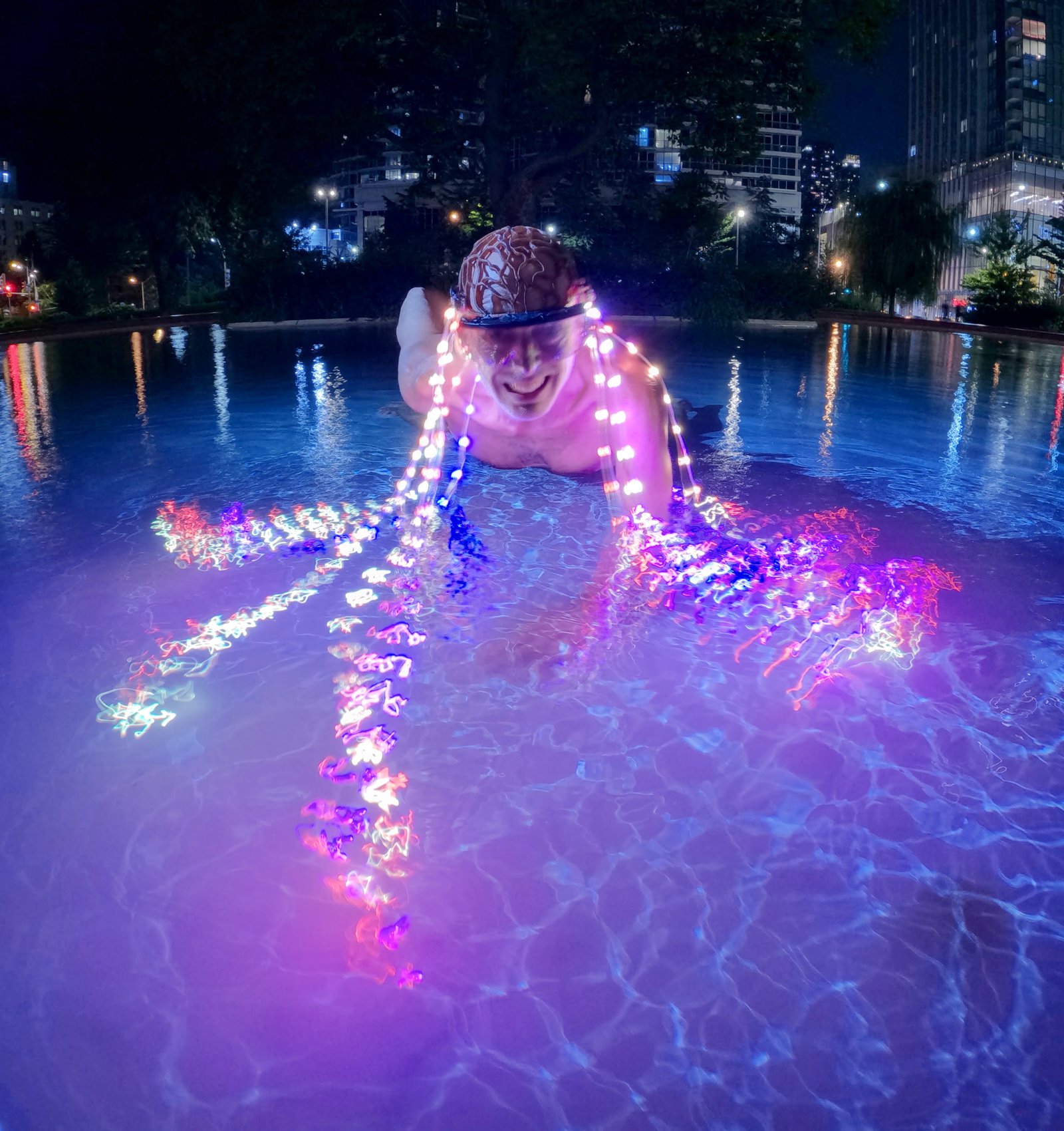
Hands meeting water, light-painted at Love Park Pool, Toronto.
A game played by touching and being touched by water. Players, from shore, from a float, or waist-deep, strike the surface of the water to the beat of a sea shanty (after “The Wellerman”), connecting with waterfronts where swimming is not allowed by at least putting hands and feet in the water. A bodyboard rigged with a waterproof microcontroller and inertial sensor turns the strikes into music.
Two players each wore a consumer EEG headband during play and during a resting baseline. In both single-participant recordings theta rose while beta and gamma fell, a direction consistent with calm absorption rather than movement artifact, reported as descriptive, hypothesis-generating observations. Played at Peter Street Pool and Love Park Pool, Toronto.
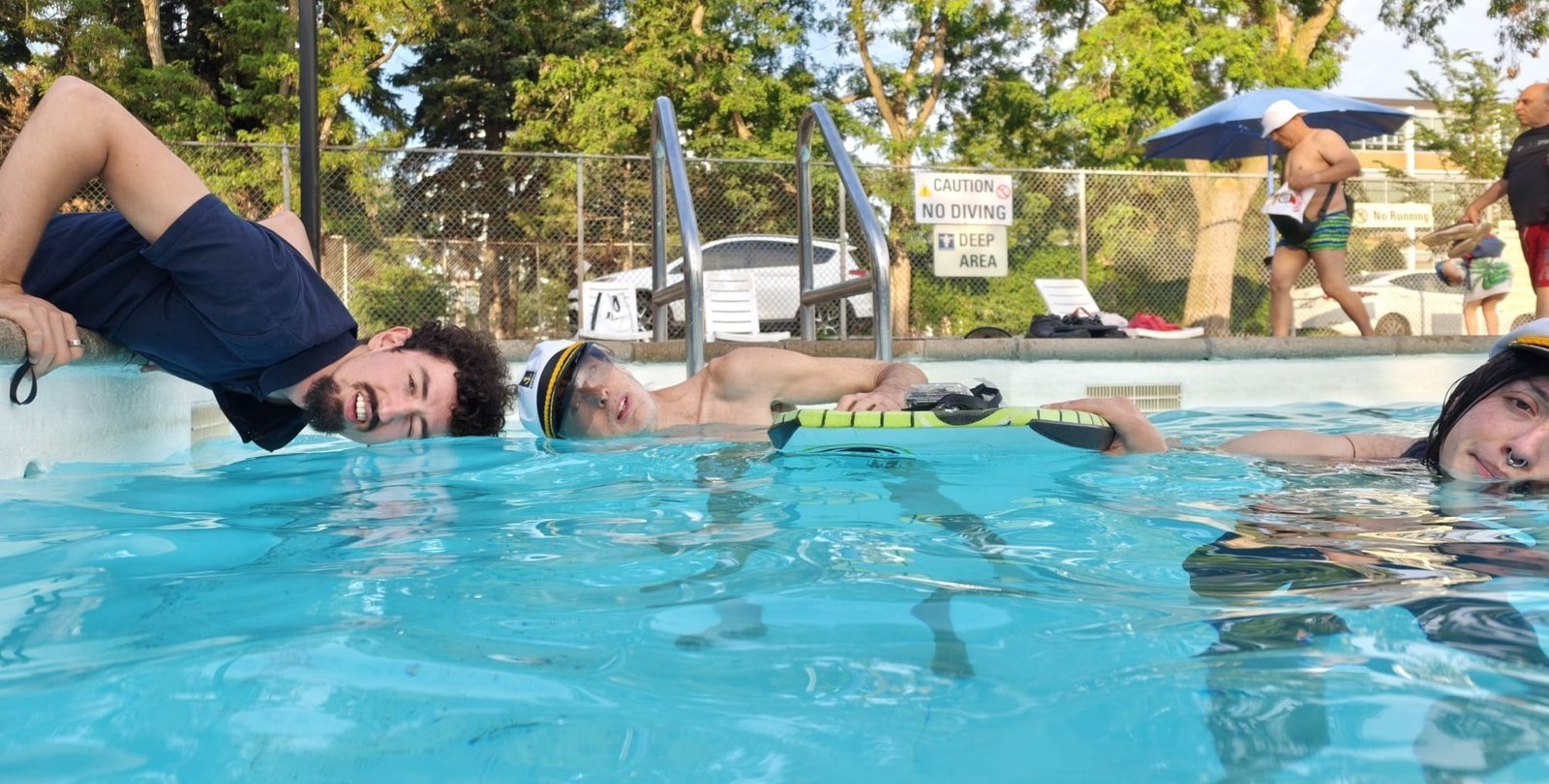
Watermann at Peter Street Pool: players use small floating supports while striking the water to the beat; the green bodyboard carries a waterproof microcontroller and inertial sensor.
Abstract
We present Watermann, a game played by touching and being touched by water: players slap the surface to the beat of a sea shanty (“Soon may the Watermann come,” after “The Wellerman”). The game encourages people to connect with a waterfront where swimming may not be allowed by at least putting their hands and feet in the water to the beat. We recorded brain activity with two consumer electroencephalography (EEG) headsets, one worn by each of two participants, while they hit the water to the shanty and during a resting baseline. In both single-participant recordings, frontal–temporal theta and the theta/beta ratio rose while beta and gamma fell and a task-engagement index dropped. The shift was large in one participant and small and statistically non-significant in the other. Its direction is opposite to a movement/muscle artifact and consistent with calm, low-arousal absorption. Because the study has one participant per headset, a blocked design, and consumer hardware, we report descriptive, hypothesis-generating observations rather than confirmatory effects. The fNIRS recording is reported as a feasibility result. A larger, counterbalanced study should now test whether slapping water to a shanty calms rather than excites the brain.
Authors
Steve Mann, Alexander Vicol, Xiaoming Chen, Jianzi Zhang, Yubin Zhang, Michel Alejandro Herrera Viyella, Kaiyi Yuan, Rhyzome Adkisson
Links
- Paper on IEEE Xplore (DOI 10.1109/GEM72276.2026.11747021)
- Related project: Swiminalization and (K)No(t)-Swimming
- Related project: Boardmusic