DiaShoe: A Smart Shoe for Diabetic Health Monitoring with Gait and Nanoclimate Sensing
IEEE International Conference on Consumer Electronics (ICCE) 2026
Dubai, United Arab Emirates, February 2026 · Published; full paper on IEEE Xplore
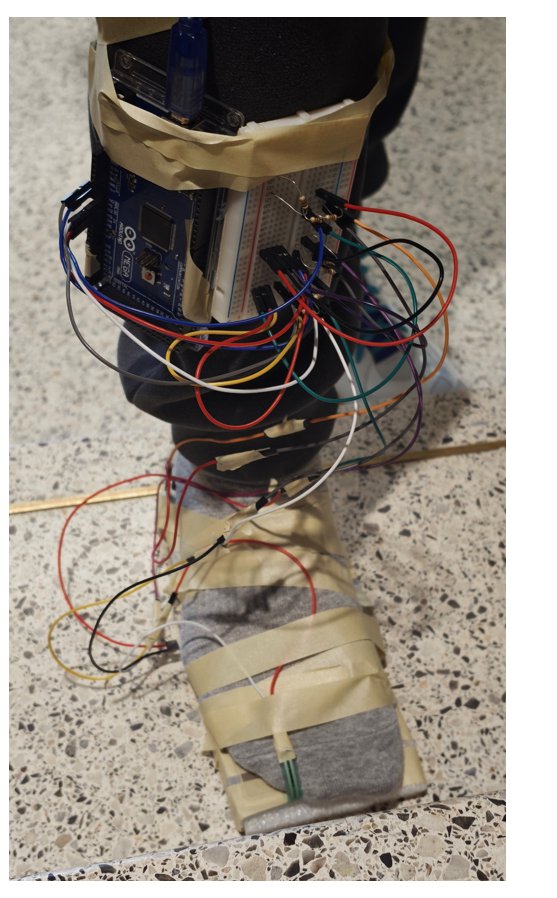
The wear-test prototype: force-sensing resistors under the foot, an inertial unit, temperature and humidity sensing, and an Arduino Mega on the shin.
Diabetic foot disease is a leading cause of preventable amputation, and loss of sensation means injuries go unnoticed. Continuous monitoring of plantar pressure together with in-shoe temperature and humidity is known to reduce ulcer risk, but existing systems are bulky. DiaShoe is a low-cost, multimodal shoe: an array of force-sensing resistors, an inertial unit, temperature and humidity sensors, and an ultrasonic distance sensor for adaptive power management.
The paper covers the hardware, a purpose-built environmental test chamber for controlled data collection, and gait classification that fits on a microcontroller: soft probability outputs from TabPFN distilled into a sub-kilobyte MLP.
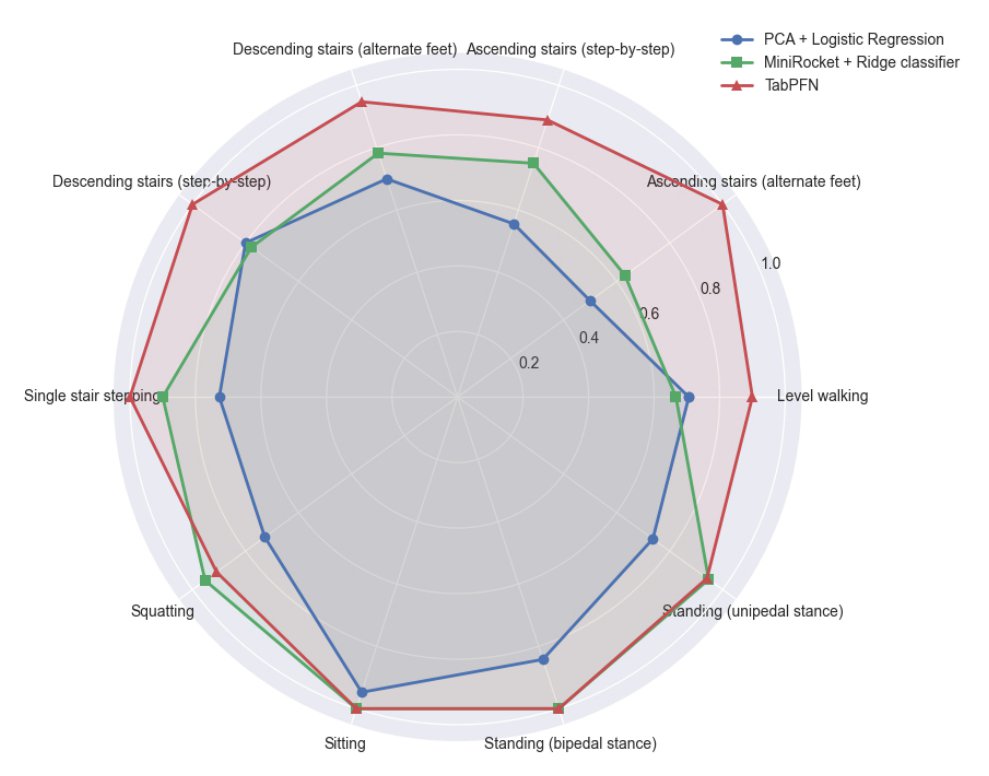
Gait classification across nine activities: PCA with logistic regression, MiniRocket with ridge, and TabPFN, whose soft outputs were distilled into a sub-kilobyte network for the microcontroller.
Abstract
Diabetic foot disease is a leading cause of preventable disability, lower-limb amputation, and mortality worldwide. Loss of sensation in the feet for individuals suffering from diabetes is common. Risk of lack of ability to perceive injuries to the feet is dangerous. Our team has developed a foot-monitoring system aiming to minimize this risk. Continuous monitoring of plantar pressure together with in-shoe temperature and humidity has been shown to reduce ulcer risk, but is bulky, and difficult to deploy at scale. At the same time, data-driven gait classification approaches increasingly rely on deep learning models whose memory and compute requirements exceed the capabilities of microcontroller-class wearable hardware. We present a low-cost, multimodal solution that combines an array of force-sensing resistors (FSRs), an inertial measurement unit (IMU), temperature and humidity sensing, and an ultrasonic distance sensor for adaptive power management. We describe a complete pipeline from hardware design, and wearable environmental test chamber construction, to enable controlled multimodal data collection. Soft probability outputs from TabPFN were distilled into the sub-kilobyte MLP.
Authors
Xiaoming Chen, Mo Yang, Alexander Vicol, Yawen Xiao, Richard Zeng, Wanhe Li, Steve Mann
Links
- Paper on IEEE Xplore (DOI 10.1109/ICCE67443.2026.11449711)
- Also in the Mersivity / WaterHCI December-2025 Symposium Proceedings (Zenodo)
- Related project: ELEVATE: XR for Elevators