Wearable Technology to Mitigate Bad Elevator Design
IEEE International Conference on Consumer Electronics (ICCE) 2026
Dubai, United Arab Emirates, February 2026 · Published; full paper on IEEE Xplore
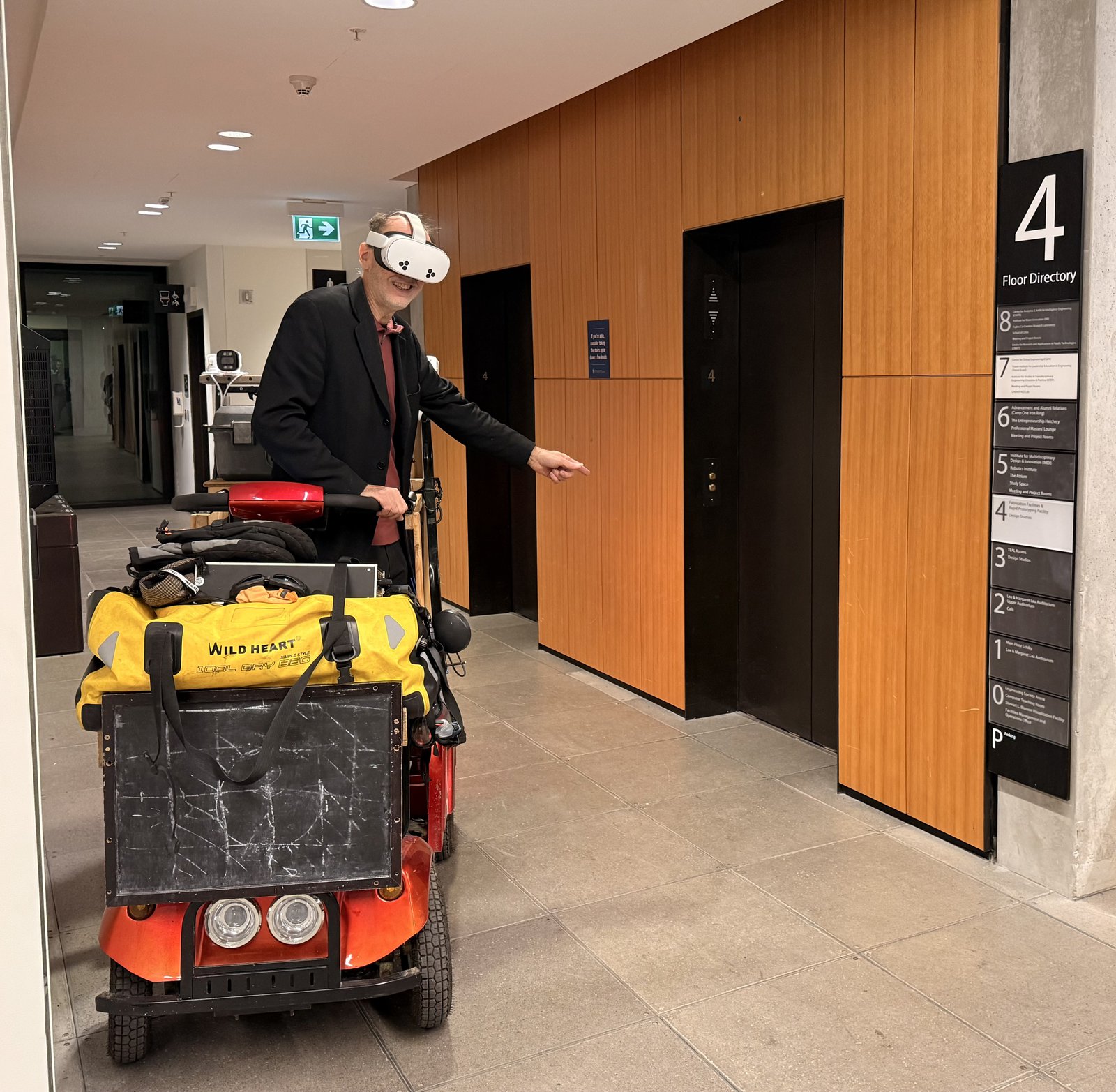
Testing at the Myhal Centre, University of Toronto, whose upper floors have no indicators of where the elevators are.
Banks of elevators often give no hint of which door will open next, so wheelchair and mobility-aid users have to rush. ELEV-AI-T.E. (ELEVATE), the Elevator AI Tracking and Enhancement System, overlays each door with the floor its car is currently on, in XR, and adds an AI assistant that tracks elevator movement in real time with computer vision.
It was tested at the University of Toronto’s Myhal Centre, which shows elevator positions on the ground floor but not upstairs. Accurate spatial guidance, delivered in the headset, for the people who most need advance notice.
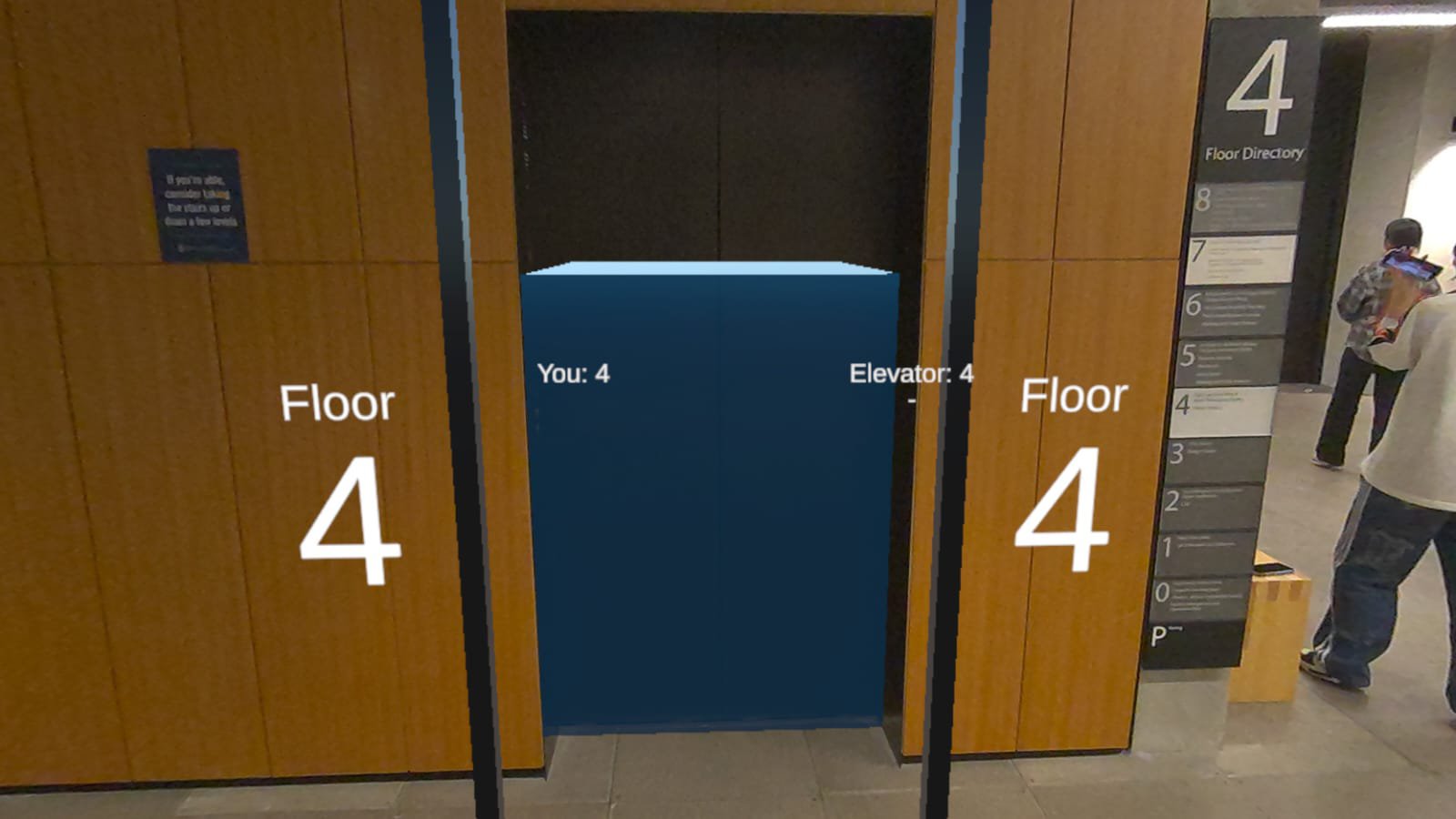
The XR overlay: each door shows the floor its car is on, so the user can move to the right door before it opens.
Abstract
In many establishments, a large group of elevator doors are grouped together but lack visual cues as to which door will open. Persons with disabilities using wheelchairs or other mobility devices must then rush to maneuver to whichever door opens. Having no advance notice results in rushed movement that creates a safety risk. We address this problem with an eXtended Reality (XR) system to provide location indicators that show the floor level the elevators are currently at. XR technologies extend the user’s ability to eXperience reality; Elevator AI Tracking & Enhancement System (ELEV-AI-T.E/ELEVATE) aims to extend visual ability for users with mobility aids boarding elevators. Our proposed XR elevator system also provides an AI-powered assistance system integrated into the XR application, which monitors real-time elevator movement using computer vision. This system was tested at the University of Toronto’s Myhal Centre, because this building provides elevator location indicators on the first floor but none on the upper floors, making it a suitable testing environment. By embedding these predictions into an XR application, the proposed solution delivers accurate spatial guidance to users with disabilities, demonstrating how adaptive technologies can enhance accessibility and improve interaction within everyday environments.
Authors
Stefan Masic, Nagham Sabbour, Alexander Vicol, Iman Cheema, Eraj Zaidi, Nathes Mehanathan, Steve Mann
Links
- Paper on IEEE Xplore (DOI 10.1109/ICCE67443.2026.11449710)
- Also in the Mersivity / WaterHCI December-2025 Symposium Proceedings (Zenodo)
- Related project: ColourSenseXR
- Related project: DiaShoe