A Consumer EEG–Driven Word Keyboard for Assistive Communication
IEEE 39th International Symposium on Computer-Based Medical Systems (CBMS) 2026
Limassol, Cyprus, June 2026 · Published; full paper on IEEE Xplore

The word keyboard: lateral eye movements move the highlight, a deliberate blink selects, and the word is spoken aloud.
Motivated by clinical discussions at Holland Bloorview Kids Rehabilitation Hospital, this project asks whether consumer-grade EEG can support augmentative and alternative communication (AAC) without a screen-tracking rig. The whole system is a Muse 2 headband, a smartphone and a laptop.
Four-channel EEG is streamed over OSC, cut into two-second windows and classified into blink, left, right and background states by a compact TensorFlow Lite network. A word keyboard is navigated with lateral eye movements and selections are made with deliberate blinks, with output through text-to-speech and keyboard emulation. Offline accuracy was 94.2%, strongest on blink detection.
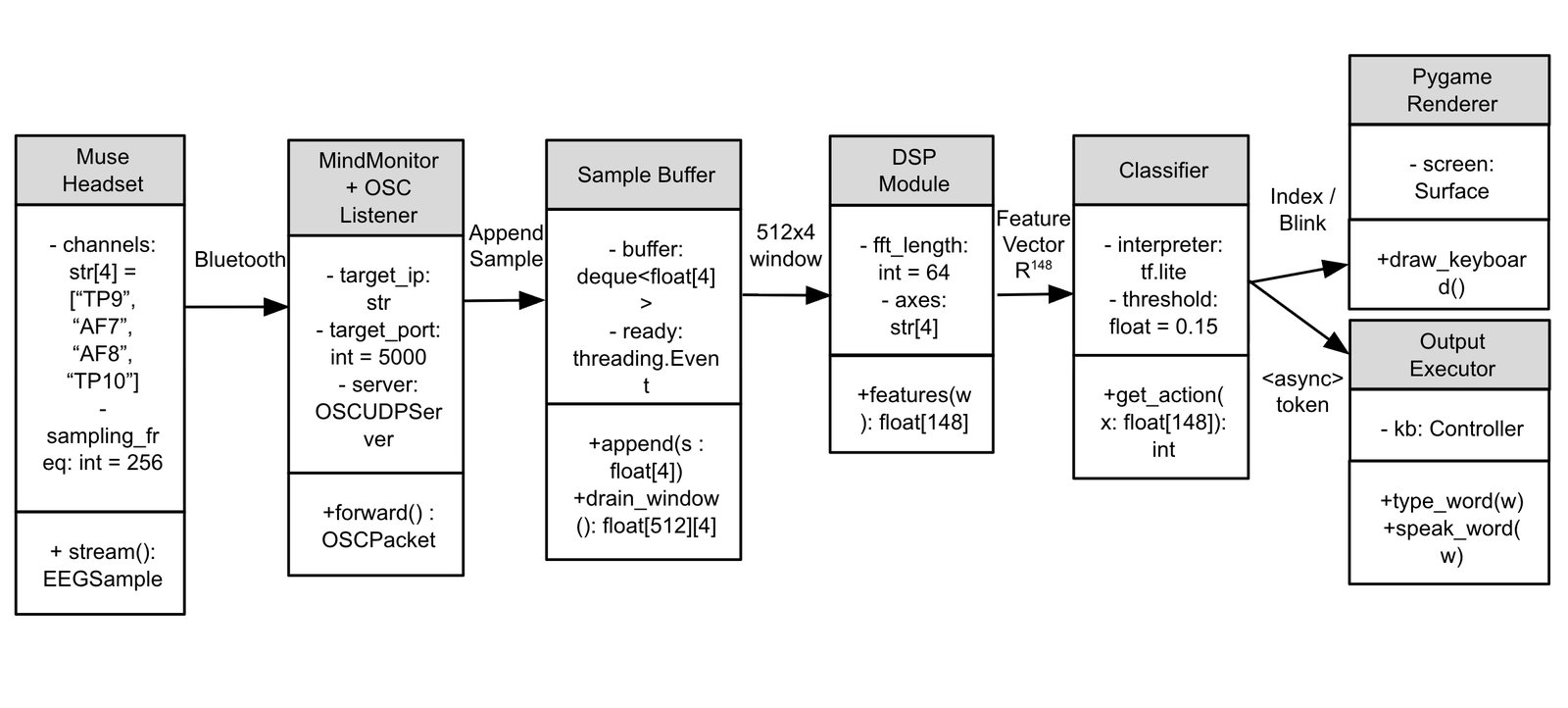
Pipeline: Muse 2 over Bluetooth, OSC to the laptop, two-second windows, spectral features, a compact TensorFlow Lite classifier, then the keyboard, text-to-speech and HID output.
Abstract
We present a low-cost brain–computer interface for assistive communication using only consumer hardware: a Muse 2 EEG headband, smartphone, and laptop. Raw four-channel EEG is streamed via OSC, processed in two-second windows, and converted into spectral features for classification into blink, left, right, and background states using a compact TensorFlow Lite neural network. A Pygame-based word keyboard enables navigation through lateral eye movements and selection via deliberate blinks, with output delivered through text-to-speech and HID emulation. Offline evaluation achieved an overall accuracy of 94.2% and a mean F1-score of 94.1%, with strongest performance in blink detection. The system demonstrates the feasibility of consumer-grade EEG as a foundation for accessible AAC research while highlighting the engineering challenges that remain before dependable clinical use.
Authors
Alexander Vicol, Xueqi Yang, Bingxuan Yang, Steve Mann
Links
- Paper on IEEE Xplore (DOI 10.1109/CBMS69103.2026.00083)
- Related project: Brain Data Visualization in VR/XR
- Related project: XRaudinary