Brain Data Visualization in VR/XR
IEEE International Conference on Consumer Electronics (ICCE) 2026
Dubai, United Arab Emirates, February 2026 · Published; full paper on IEEE Xplore
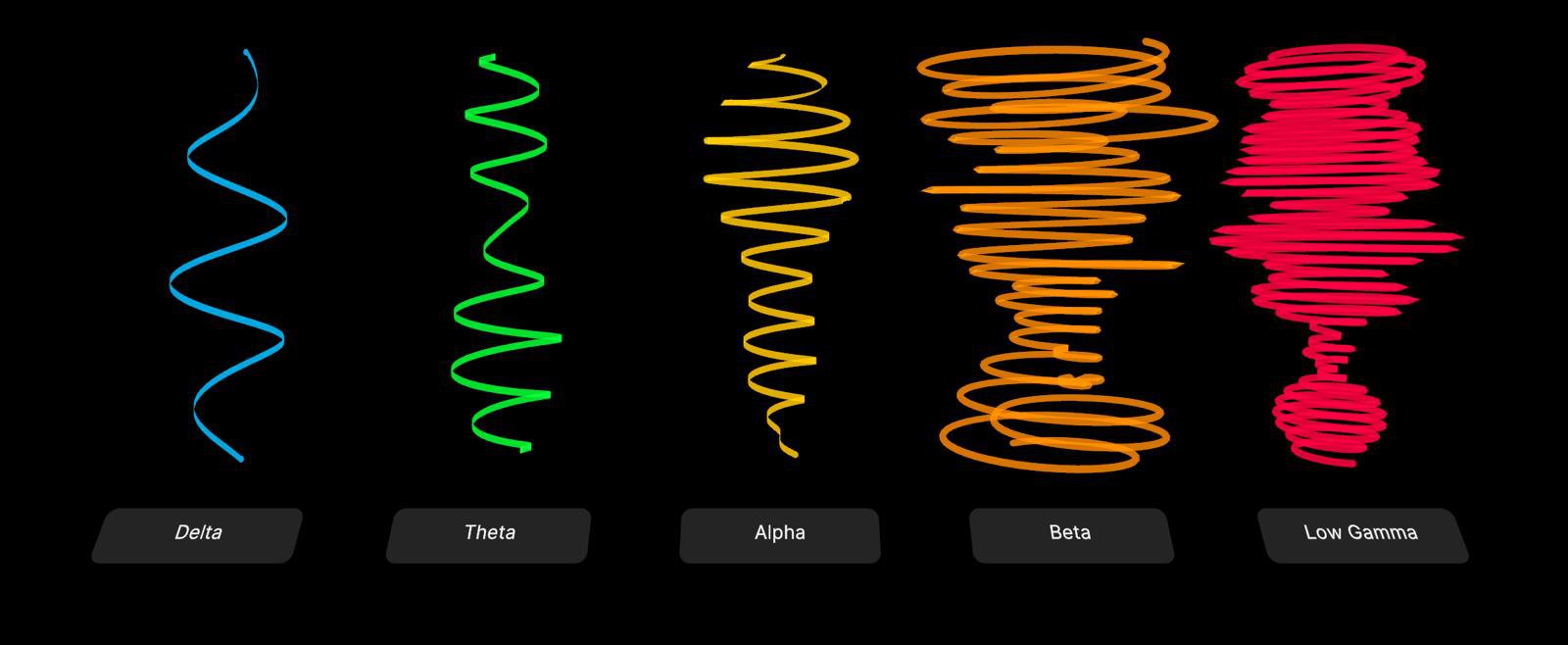
One spiral per EEG band, delta to low gamma: amplitude sets the radius and the Hilbert phase drives the turn.
As VR/XR headsets go mainstream, immersive systems should connect people rather than isolate them. This SWIM-inspired (Sequential Wave Imprinting Machine) brainwave visualizer lets wearers see band-limited EEG activity as shared, spatial traces: each band drives a column of particles for relative power and a Hilbert-transform spiral whose radius and phase follow the analytic signal, placed in 3-D space in Unity on a standalone headset.
Meant as a readable, artistic, qualitative display that supports social presence, accessibility and empathy, not as a medical instrument.
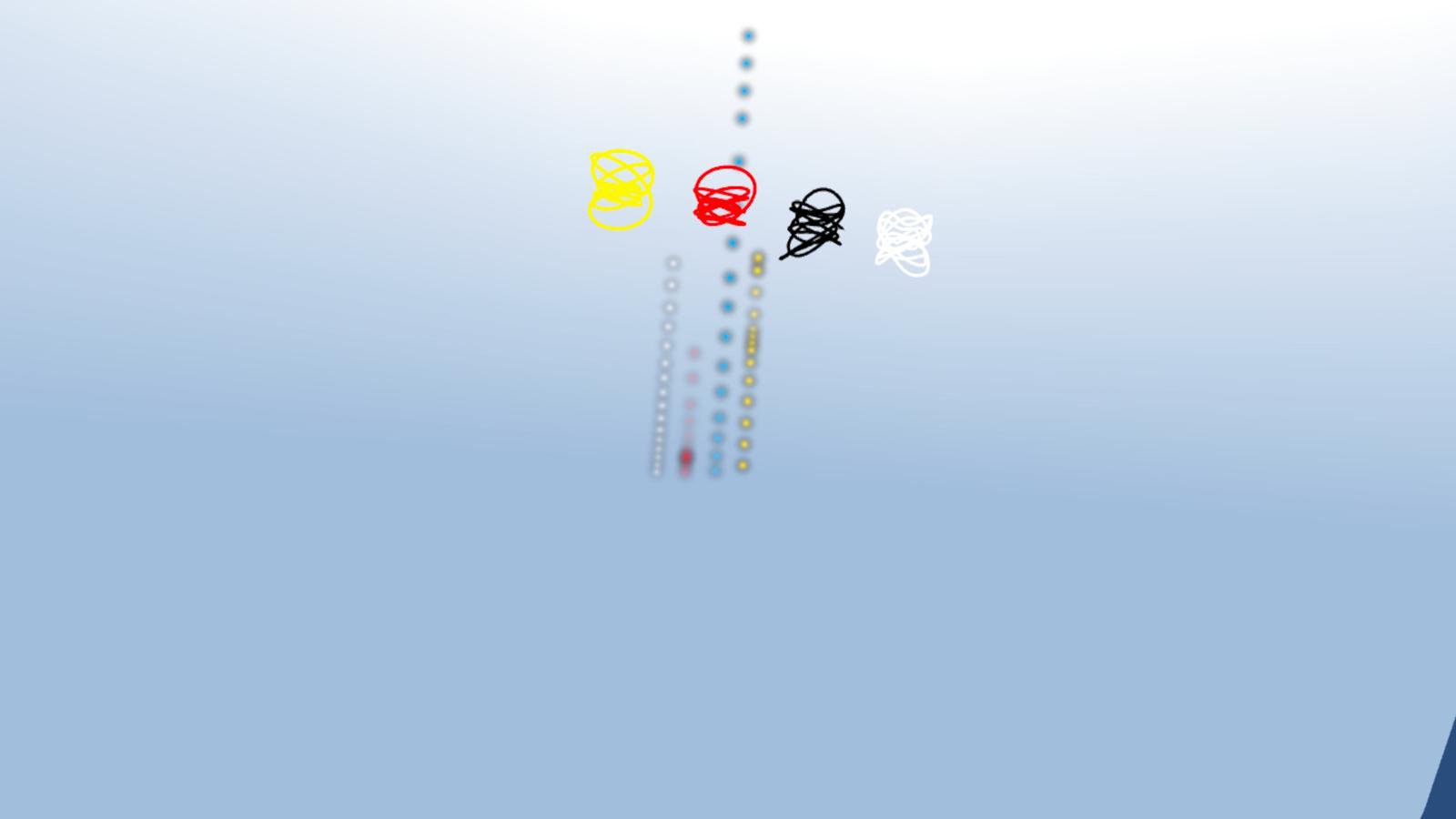
The headset view: particle columns show relative band power while the spirals imprint phase and amplitude in space.
Abstract
As Virtual Reality (VR), and, more generally, eXtended Reality (XR) headsets become mainstream, the importance of ensuring that technology connects users, rather than isolating them, grows. We propose a SWIM (Sequential Wave Imprinting Machine)-inspired, XR (eXtended Reality) brain wave visualizer that enables users to see each other’s electroencephalogram (EEG) brain wave data while wearing a VR/XR headset. Classic SWIM uses a scanned light array and persistence-of-exposure (human eye or photography) to make otherwise invisible waves visible, thereby extending intelligence. Our visualizer simulates the SWIM and thus does the same for relative frequencies of the alpha, beta, theta, and gamma brain waves. In the current prototype, we demonstrate the feasibility of visualizing EEG data (currently simulated) to the application user, with particular brain wave states captured and viewed. This provides a clear path toward enabling individuals to view the brain waves of other people using live-streamed data in future work, thus augmenting interconnectivity and increasing empathy via technology. Our system maps band-limited features to spatial, colour, and particle effects around the user’s head, or wherever the user decides to place the visualization (by selecting and dragging in VR/XR space). This application could help individuals with diverse cognitive or neurodevelopmental profiles perceive and understand mental states (e.g. stress or calmness) in others, while also serving as an artistic and social visualization of otherwise invisible neural dynamics.
Authors
Alexander Vicol, Stefan Masic, Steve Mann
Links
- Paper on IEEE Xplore (DOI 10.1109/ICCE67443.2026.11449657)
- Also in the Mersivity / WaterHCI December-2025 Symposium Proceedings (Zenodo)
- Related project: EEG Word Keyboard
- Related project: State-of-Float