State-of-Sleep: Wearable EEG Sleep Study Before, During, and After Hyperbaric Oxygen Therapy
IEEE 39th International Symposium on Computer-Based Medical Systems (CBMS) 2026
Limassol, Cyprus, June 2026 · Published; full paper on IEEE Xplore
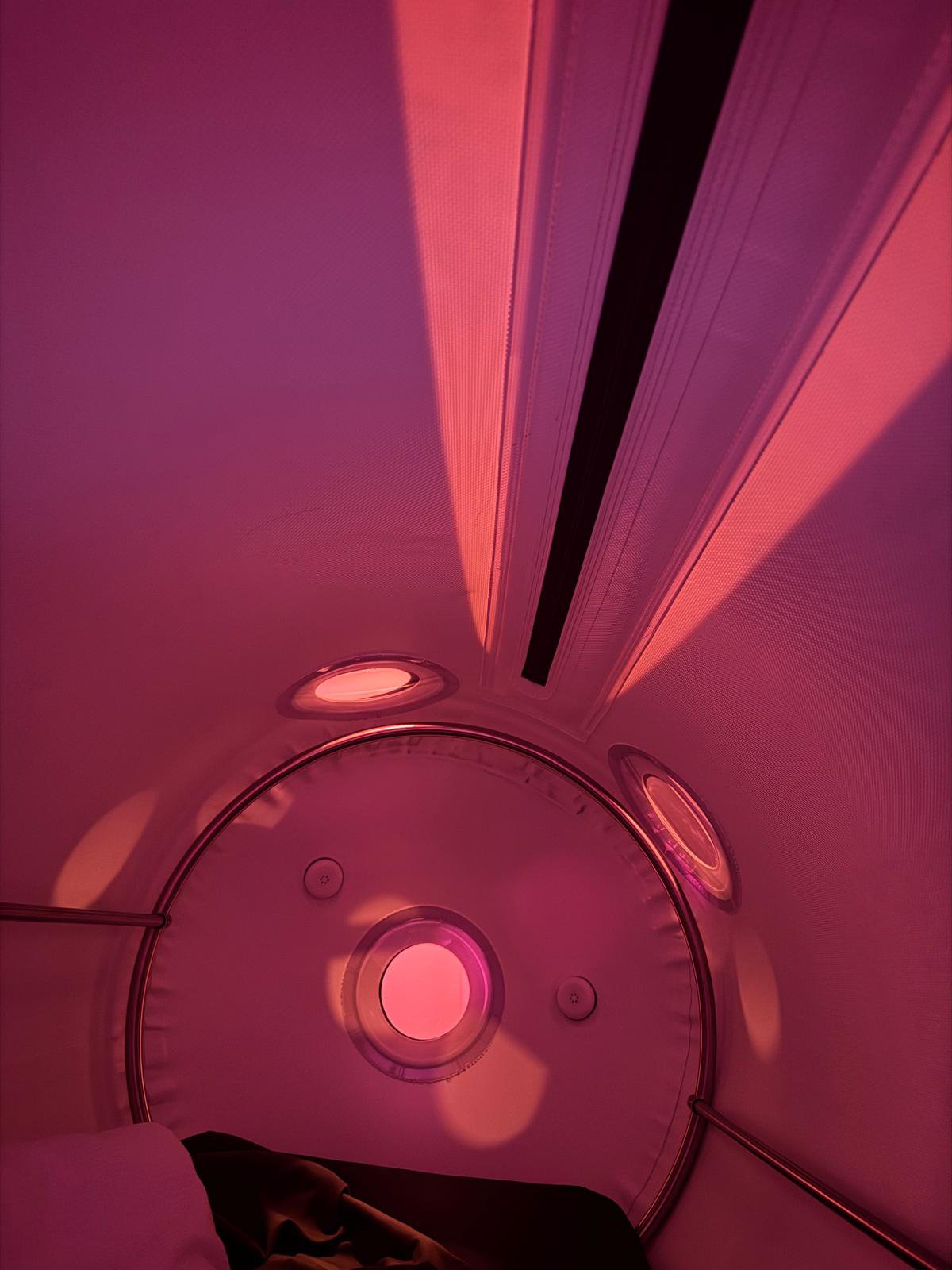
Inside the OxyNova portable chamber at 1.4 ATA, where the sleep sessions were recorded.
Sleeping inside a hyperbaric chamber combines hyperoxia, sensory isolation and postural confinement. Over two sessions in a portable OxyNova chamber at 1.4 ATA, a Muse-class headband recorded continuous 4-channel EEG that was split into three phases: before (settling), sleep (sustained NREM) and after (waking).
Delta dominated the settling phase, spindle-band activity rose during sleep while the theta/beta ratio fell, and delta partially recovered afterwards as the participant returned toward wakefulness. A companion sleep-staging app agreed on the phase boundaries. Electrode contact degraded during sleep, a practical lesson for overnight wearable recordings.
Abstract
Sleep inside a hyperbaric oxygen therapy (HBOT) chamber presents a unique confluence of hyperoxia, sensory isolation, and postural confinement. Understanding how neural oscillatory dynamics shift before, during, and after sleep in this environment is essential for evaluating HBOT as a sleep-related intervention. We report a single-participant feasibility study spanning two sessions inside an OxyNova portable chamber operated at 1.4 ATA. Continuous 4-channel EEG was recorded at 256 Hz using Muse-class wearable headbands, and each recording was segmented into three phases: Before (pre-sleep settling), Sleep (sustained NREM), and After (post-sleep waking). During the Before phase, delta-band power comprised 62–71% of total spectral power as participants transitioned from wakefulness to drowsiness. During Sleep, the spectral profile shifted further: the theta/beta ratio (TBR) decreased to 0.28–1.41, sigma-band activity (12–15 Hz) rose to 2.4–6.9%, and delta/theta ratio (DTR) remained elevated (> 2.8), indicating sustained NREM with spindle activity. In the After phase, delta power partially recovered to 27–56%, accompanied by increased TBR relative to Sleep, suggesting a gradual return toward wakefulness. A companion sleep-staging application corroborated the phase boundaries, showing 40 min of scored sleep (59% light, 41% deep) in Session 1. Signal-quality analysis revealed declining electrode contact during sleep, an important practical limitation for overnight wearable recordings. These results demonstrate feasibility and provide the first before–during–after spectral comparison of wearable EEG during sleep in HBOT.
Authors
Alexander Vicol, Gianella Bejar-Alvarez, Steve Mann
Links
- Paper on IEEE Xplore (DOI 10.1109/CBMS69103.2026.00061)
- Also in the Mersivity / WaterHCI 2026 Symposium Proceedings (Zenodo)
- Related project: State-of-Study in HBOT