State-of-Study in Hyperbaric Oxygen Therapy: Wearable EEG and fNIRS During an HBOT Session
IEEE 39th International Symposium on Computer-Based Medical Systems (CBMS) 2026
Limassol, Cyprus, June 2026 · Published; full paper on IEEE Xplore
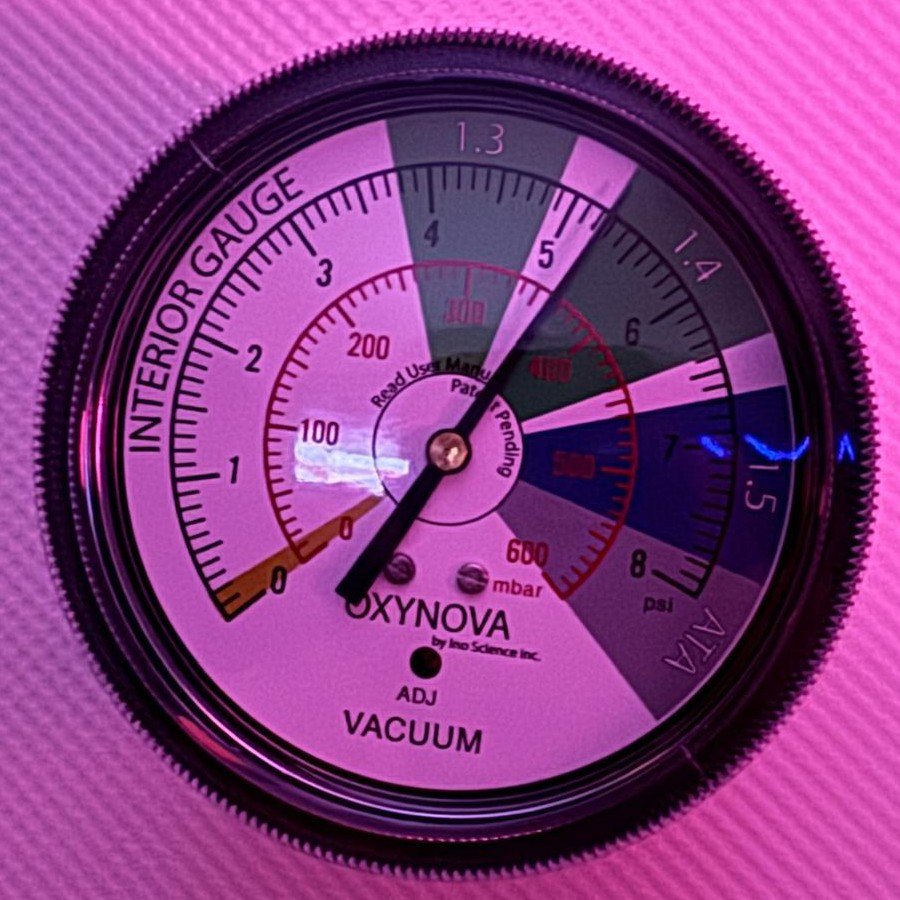
The interior gauge of the OxyNova soft-shell chamber during the session.
Hyperbaric oxygen therapy (HBOT) puts the body under elevated oxygen pressure inside a sealed chamber, which may change both cerebral blood flow and brain rhythms. In this single-participant feasibility study, two Muse-class headbands captured 4-channel EEG and, on the Muse S Athena, 8-channel near-infrared spectroscopy (fNIRS) before and during a session in a portable chamber.
The theta/beta ratio rose in the chamber, frontal alpha asymmetry moved toward zero, and the fNIRS estimates showed increased cortical oxygenation, with a small but significant epoch-level correlation between TBR and oxygenated haemoglobin. The paper also sets out the safety considerations and a reusable analysis pipeline for controlled studies to follow.
Abstract
Hyperbaric oxygen therapy (HBOT) exposes the body to elevated partial pressures of oxygen inside a pressurized chamber, a setting that may influence cerebral hemodynamics and neural oscillatory activity. We report a single-participant feasibility study using two Muse-class wearable headbands (Muse 2 for pre-session baseline; Muse S Athena for in-chamber recording) to simultaneously capture 4-channel EEG (256 Hz) and, on the Athena device, 8-channel near-infrared spectroscopy (fNIRS) at 730 nm and 850 nm. Using a reproducible pipeline (0.5–30 Hz bandpass, 5 s epoching, amplitude-based artifact rejection, Welch PSD), we compare spectral features before and during HBOT. Pooled theta/beta ratio (TBR) increased from 2.39 ± 2.23 (316 epochs, pre-session) to 3.56 ± 3.64 (383 epochs, in-chamber), a relative increase of 49%. Frontal alpha asymmetry (FAA) shifted from +1.22 to near zero. During the HBOT session, fNIRS-derived hemodynamic estimates at inner optode positions showed positive HbO and negative HbR, consistent with increased cortical oxygenation. Epoch-level correlation analysis revealed a significant positive association between TBR and HbO at both left-inner (r = 0.16, p = 0.002) and right-inner (r = 0.14, p = 0.008) positions. These results are preliminary and demonstrate feasibility of concurrent wearable EEG + fNIRS monitoring during HBOT, along with a reusable analysis scaffold for future controlled studies.
Authors
Alexander Vicol, Gianella Bejar-Alvarez, Steve Mann
Links
- Paper on IEEE Xplore (DOI 10.1109/CBMS69103.2026.00123)
- Also in the Mersivity / WaterHCI 2026 Symposium Proceedings (Zenodo)
- Related project: State-of-Sleep in HBOT
- Related project: State-of-Flight