Efficiency as a Heuristic for Physical Interpretation: Proof by Simulation, Falsification, and an Expanding Computational Horizon
28th Annual Mersivity / WaterHCI Symposium 2026
Toronto and online, March 30 to May 10, 2026 · Published in the symposium proceedings (open access on Zenodo)
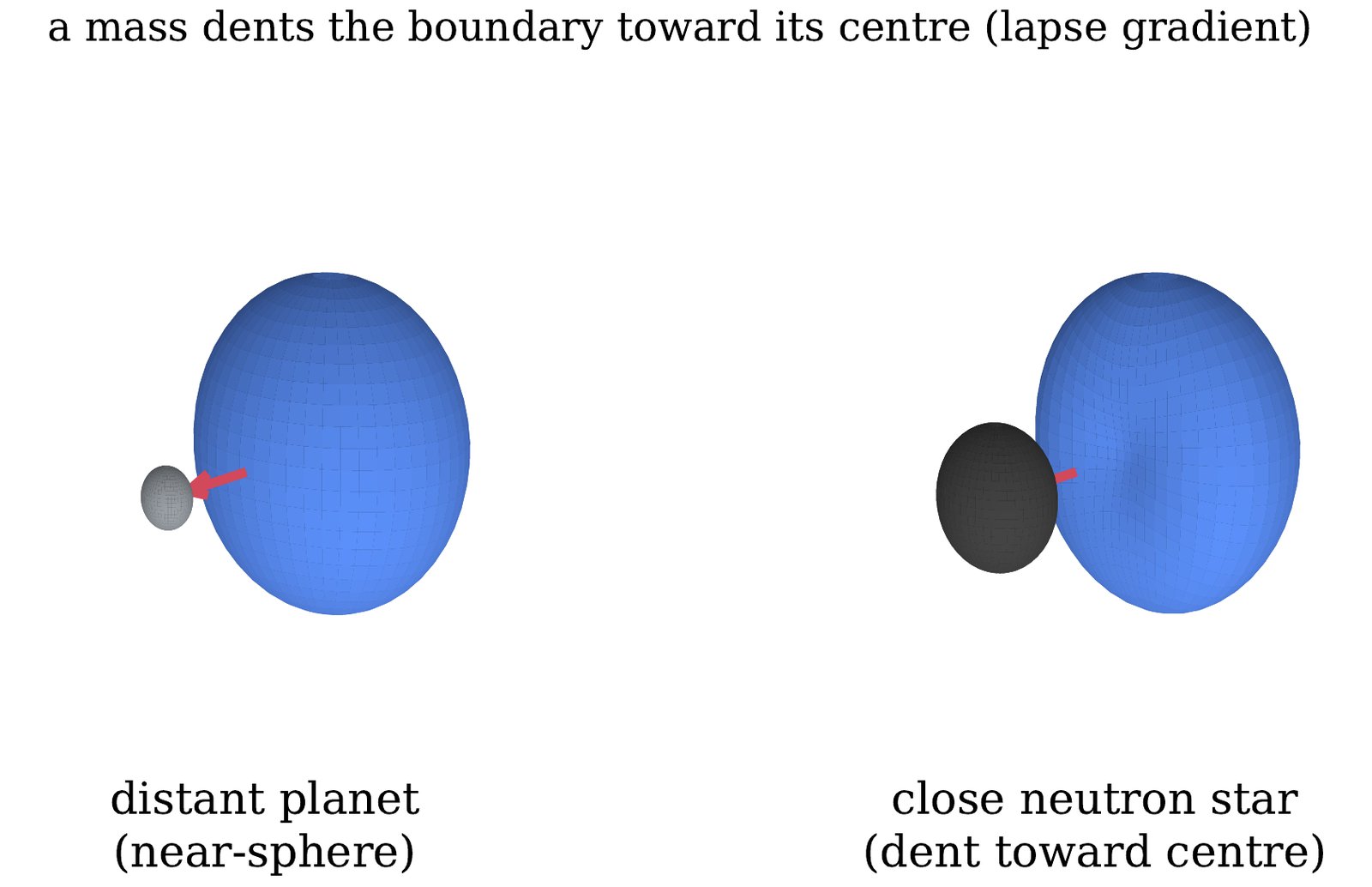
The blob in curved spacetime, from the paper: a distant planet leaves the boundary a near-sphere, a close neutron star dents it toward its centre. A mass dents the boundary toward its centre, the lapse gradient made visible.
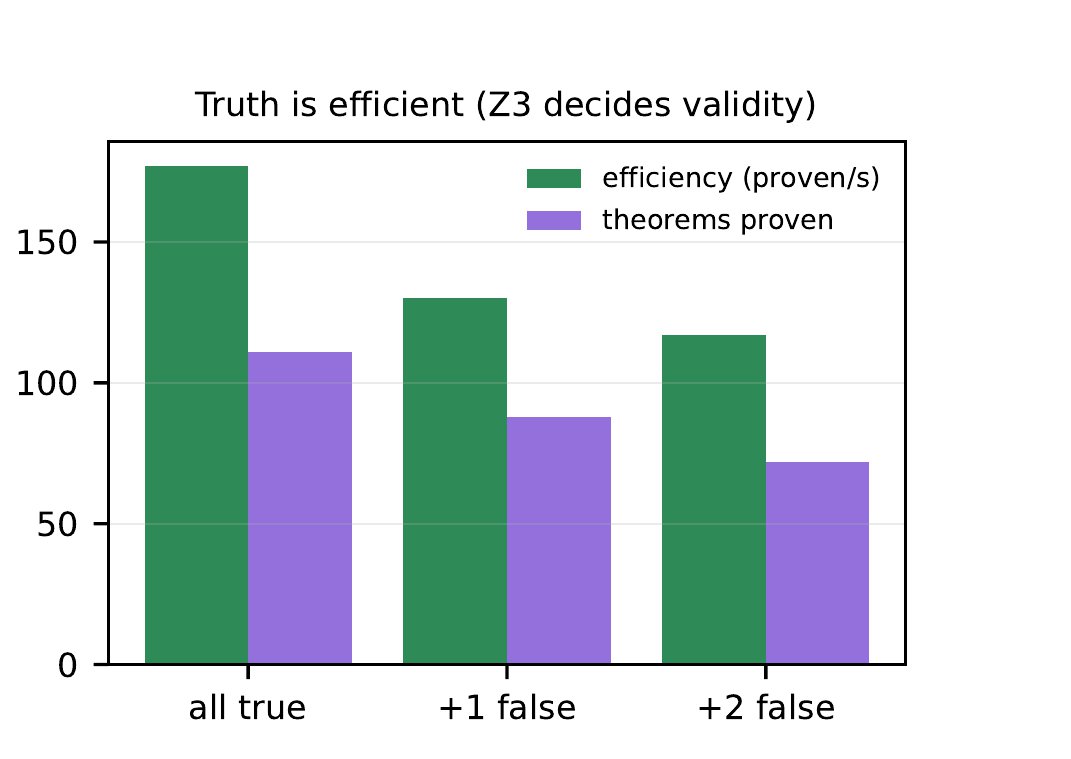
A recurring intuition in physics is that nature is efficient: the representation in which a phenomenon becomes cheap to compute often feels closer to the phenomenon. We promote that to a testable question and attack it with two engines, proof by simulation and falsification by a satisfiability solver, on a catalogue of 52 physics debates. The claim is deliberately conditional: efficiency is not truth, but when a search is grounded in the established record, true premises stay consistent and keep producing verified consequences, while false ones contradict it and waste the search.
Abstract
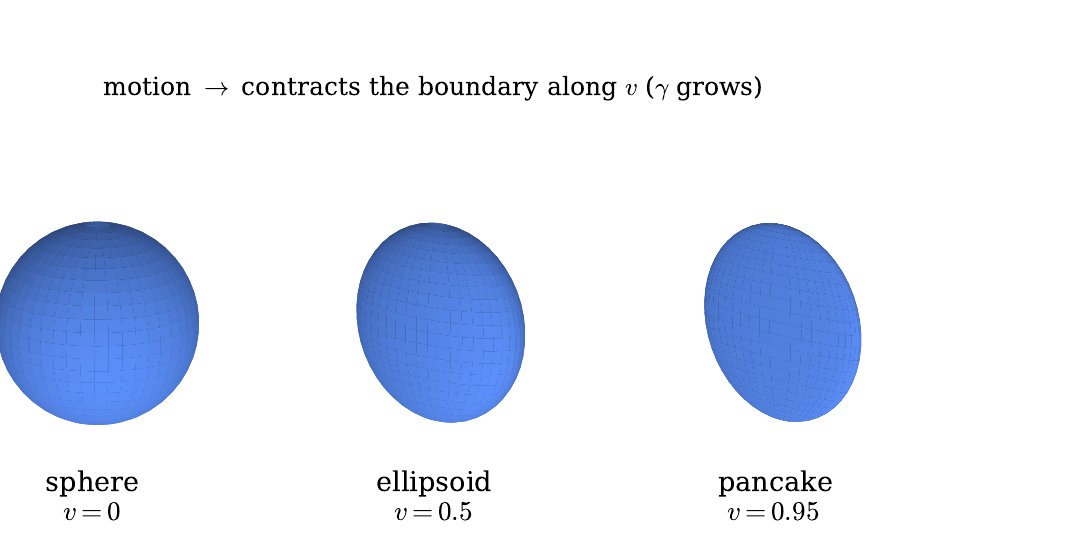
We study a simple but beautiful idea: when two possible theories of the universe both give locally plausible logical and analytical outcomes, the one that is more efficient with a universe/multiverse simulator may be closer to the one that is true. The idea is one to be approached with caution because efficiency alone can reward a shortcut, a clever encoding, or a false but simple premise. We therefore test it with two complementary engines. The first, proof by simulation, runs competing theories on a simulation that was built on mathematical axioms and properties identical to what exists in current literature. For the given theories, however, the literature answer is hidden, and then we evaluate which view produces more verified structure per unit of work; the one with higher efficiency, and lower (ideally zero) contradictions, is the winner and implied to be the potential correct theory. We reproduce known physics in blind falsification tests, agree with the literature on every debate when the model is tied to the physics strictly and where applicable in a 52-debate catalogue, and leave genuinely open questions open. The contribution is a mechanized, falsifiable lens for asking when efficiency is evidence and when it is only framing.The second, falsification, gives each side its own theory and a shared measurement, then lets an SMT verifier discard the side that becomes self-contradictory. The central claim is not that efficiency proves truth. Rather, efficiency becomes informative when grounded in an established record: true premises remain mutually consistent and generate further verified consequences, while false premises introduce contradictions that slow or mislead search. In a live FOL/Z3 engine, seeding with literature-true axioms proves more theorems and yields higher discovery efficiency than seeding with false additions. We also form the concept of a "computational" universe where "blobs" which is affected by mass-energy and tested different modes of expansion, either with simulated spacetime, merely at speed of light from it's point of origin, and at the speed of light with spacetime, via the Proof by Simulation Engine. We assume that there is a "maximum information processing rate" in the universe, and deduce that this may exist for local spaces that expand, potentially, relative to the amount of information being processed. This "blob" is also realtivistic, and obeys a model of bounded computation: an expanding causal horizon whose shape, dilation, observation exposure, and horizon cap set discovery throughput. Near-spherical and quantum-scale blobs are most efficient; relativistic pancakes and capped horizons are least efficient. The same anisotropy that lowers efficiency is also the model's approximation error, so the sphere is at once the fastest and the most faithful (to physics)shape. The same geometry frames the classical/quantum boundary: the stabilizer bulk is classically efficient, while the observation edge marks where the Extended Church–Turing thesis can fail. We claim no proof of P versus NP and no new physical law.
Authors
Alexander Vicol, Steve Mann
Links
- Paper in the Mersivity / WaterHCI 2026 Symposium Proceedings (Zenodo, open access)
- Related project: When EEG Should Not Adapt
- Related project: Chirplets for Gravitational Waves