Exploring EEG as a Unified Modality for Trust Assessment in Human-Robot Interaction: A Framework for Integrated Trust Representation
27th Annual Mersivity / WaterHCI Symposium, December 2025
Toronto and online, December 4 to 21, 2025 · Published in the symposium proceedings (open access on Zenodo)
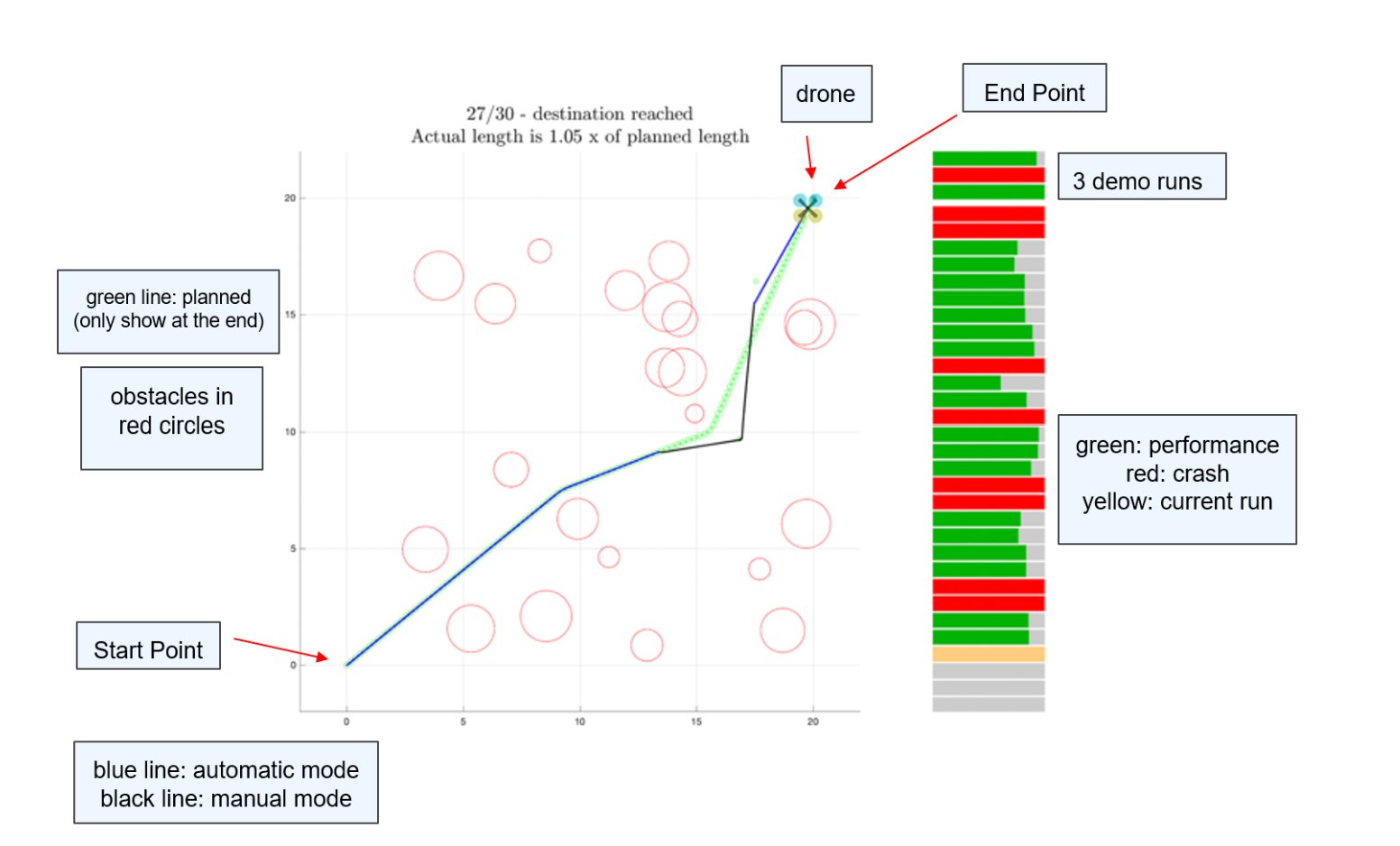
The simulation panel: the drone's planned path in green, the path it flew in blue (automatic mode) and black (manual mode) through the red-circle obstacles, and the record of runs beside it, green for performance, red for a crash, yellow for the current run.
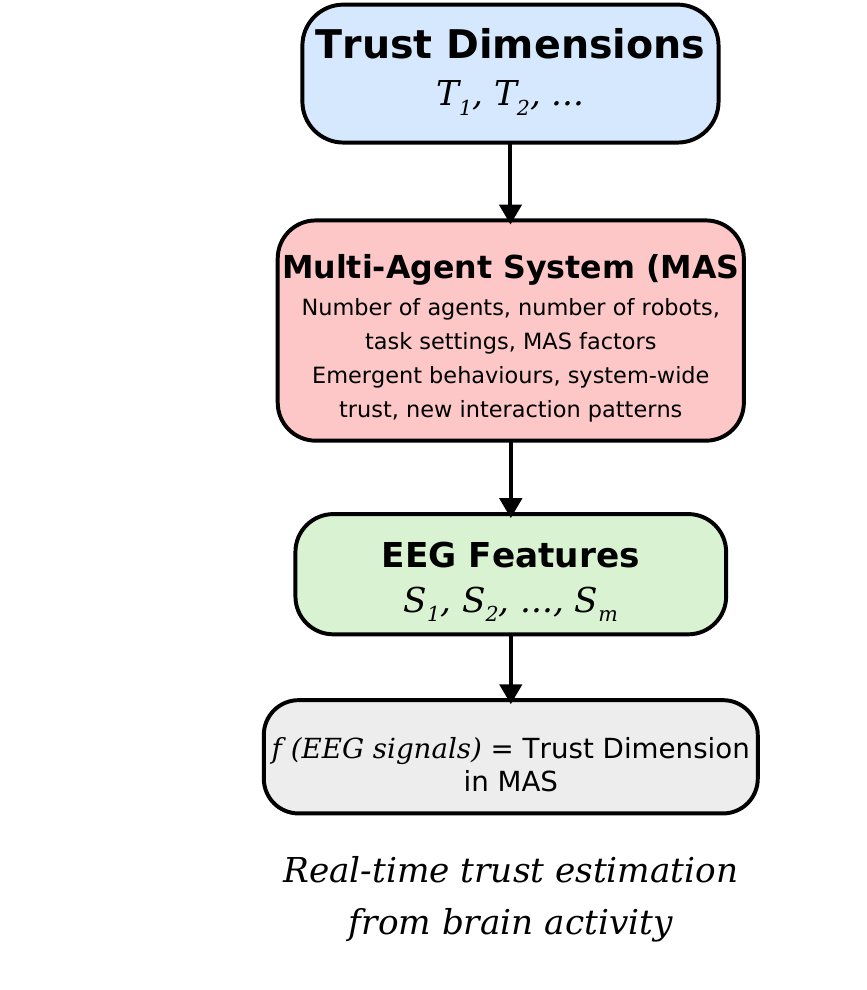
Trust decides how people supervise and rely on autonomous systems, and it mixes a logical judgement with an emotional one. This paper proposes EEG as a single modality to read both, alongside workload and reaction time, in a supervised drone task, and sketches the framework for turning those readings into one trust representation that an adaptive robot could act on.
Abstract
Trust plays a central role in human–robot interaction (HRI), influencing system safety, operational effectiveness, and human decision-making. Despite its importance, trust is difficult to quantify due to its continuous, subjective, and multidimensional characteristics. Existing trust assessment approaches largely depend on questionnaires and post hoc analysis, limiting their ability to capture the dynamic interplay between cognitive reasoning and emotional response during live interaction. While task performance measures offer insight into rational decision behavior and physiological signals reflect affective and stress-related states, these indicators are commonly evaluated in isolation. This work presents a proof-of-concept framework that explores electroencephalography (EEG) as a unified modality for trust assessment in HRI. EEG offers a multidimensional representation of neural activity across multiple frequency bands and spatial regions associated with cognitive and emotional processing. By simultaneously collecting task performance metrics and EEG signals during human–robot interaction, this study investigates whether meaningful relationships can be established between behavioral performance and neural activity. The proposed approach examines the feasibility of using EEG as a single, real-time source to represent both performance-based and emotional components of trust, with potential implications for adaptive and safety-critical autonomous systems.
Authors
Darya Zanjanpour, Alexander Vicol, Amin Khorram, Eya Ibrahim, Yaroslav Tkachenko
Links
- Paper in the Mersivity / WaterHCI December-2025 Symposium Proceedings (Zenodo, open access)
- Related project: When EEG Should Not Adapt
- Related project: Submersivity
- Related project: Metaveillance Vehicle