State of Strobe: What a Consumer EEG Headband Sees of Drowsiness, Eye Strain and Fatigue Under Flicker in a VR Headset
IEEE International Conference on Consumer Electronics (ICCE) 2027
Las Vegas, USA, January 2027 · Submitted to IEEE ICCE 2027; not yet published
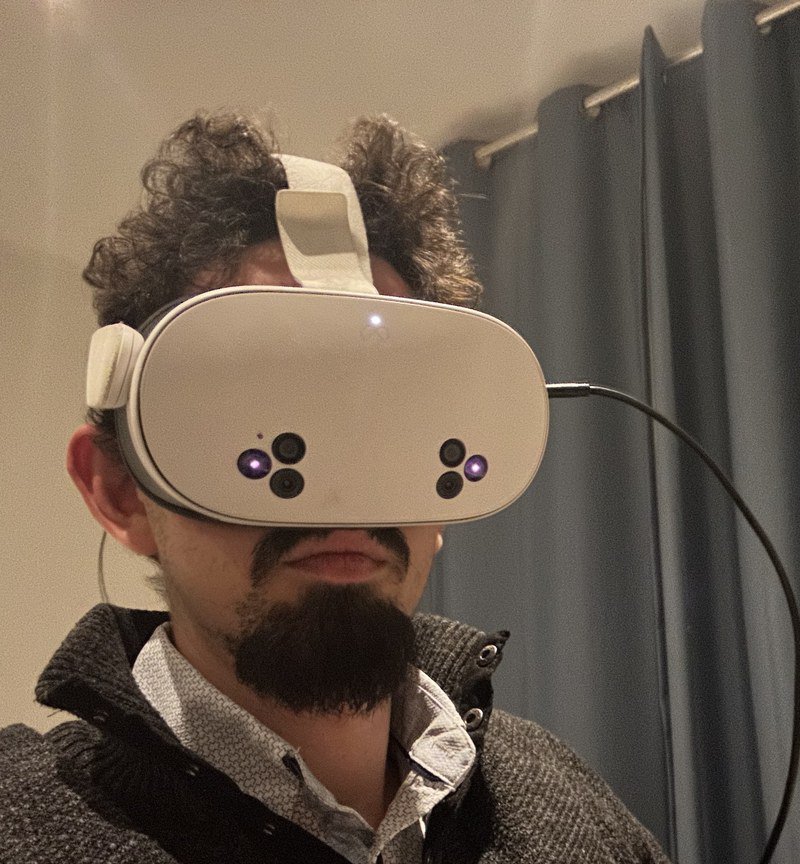
The rig: a Quest 3S over a Muse headband, the top strap holding the occipital electrode cup in place.
Reading an image from the eye means minutes of 12 Hz flicker, cell after cell, with black in between. After the first sessions the subject said the flashing made them sleepy; after an evening of two sessions they said their eyes hurt and they were not sleepy at all. We call the state a session leaves behind the State of Strobe, in the family of our State-of-Float work, and ask what the same consumer headband can see of it.
Twenty-three sessions over five weeks answer the drowsiness question: no. What flicker costs is the eyes, the blink rate doubles from the first sitting of an evening to the second, and the headband can tell when.
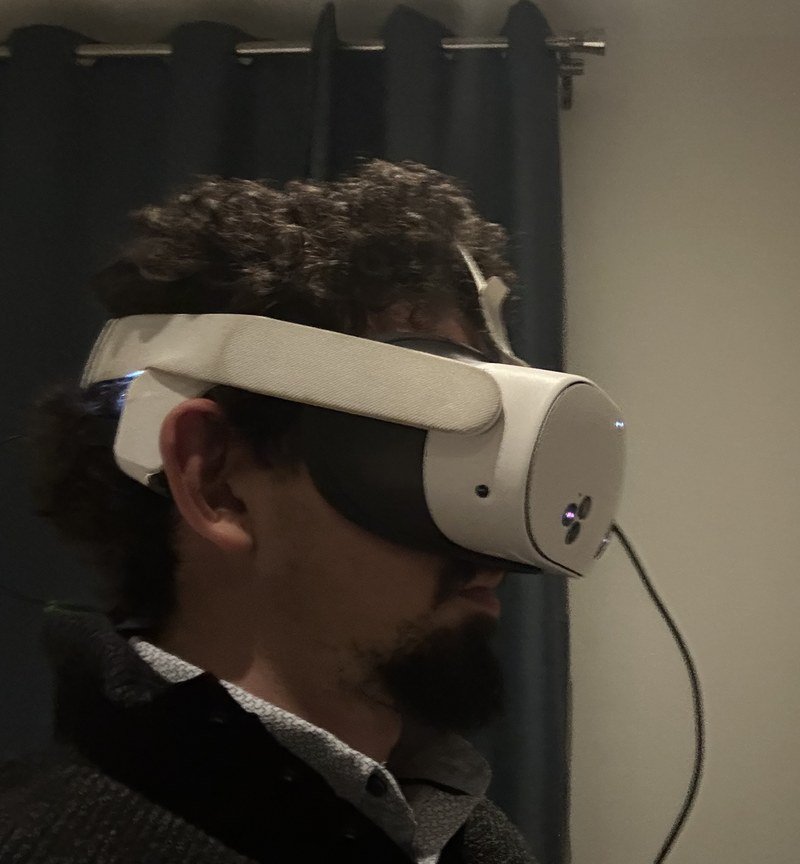
From the side: the headset is tethered to the laptop that drives the flickering page.
Abstract
Reading an image from the eye with the steady-state visual evoked potential means minutes of 12 Hz flicker in a headset, cell after cell, with black in between. After the first sessions the subject said the flashing seemed to make them sleepy; after a later evening of two sessions they said their eyes were irritated, their forehead ached, and they were not sleepy at all. We call the state a session leaves behind the State of Strobe and ask what a consumer headband (Muse 2 with one added occipital cup, under a Meta Quest 3S) can see of it. Twenty-three sessions over five weeks give the drowsiness answer: with the flicker line cut out of every band, theta/alpha on the occipital cup is the same while a cell flickers as while a black cell is shown seconds away (+0.001 log10, 95% interval -0.040 to +0.041), the only drift through a session is the wet electrode settling, a fourteen-minute session with no flicker at all drifts toward the drowsy side at least as fast, and eye closure is lower under flicker, not higher. Seven sittings analysed in depth, two in one evening, three in daytime and one at half past midnight against a reference night, give the rest: the blink rate on task doubled from the first sitting of the evening to the second (7.8 to 12.0 per minute), sat at 4 to 6 in daytime and at 8.8 after midnight; blinks stop while a cell flickers and burst the moment it goes dark, most in the evening; the forehead ache is in neither the muscle nor the EEG; and the SSVEP itself faded through the second evening sitting, collapsed within two minutes after midnight on a clean electrode, and held through two morning sittings. An eye test on the same rig, which flickers one eye at a time, splits the state in two: one eye's flicker holds the blinks back as both eyes' does, a second sitting raises the rate on the same eye (5.9 to 15.4 per minute), drowsiness is absent either way, and only the SSVEP stays with its eye. Flicker in a headset is not sedating on these markers. What it costs is the eyes, and the same headband can tell when.
Authors
Alexander Vicol, Steve Mann
Links
- Paper submitted to IEEE ICCE 2027 (Las Vegas, January 2027). A link will appear here once it is published.
- Related project: Eye as a Camera
- Related project: Literacy-Free Eye Exam
- Related project: State-of-Float